
From Migrant in the United States to Interpreter for the Mexican Presidency
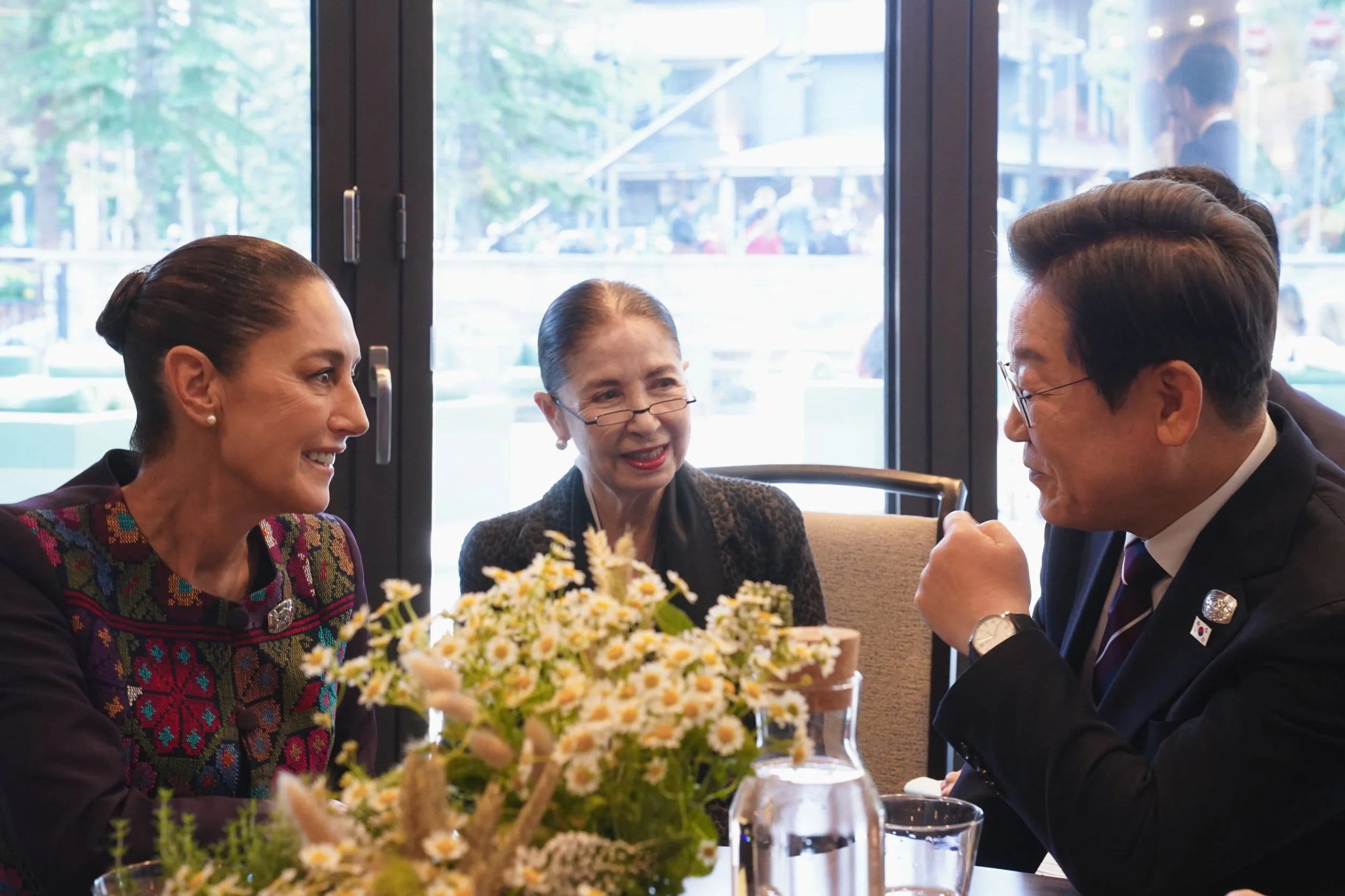
Lilia Rubio (center) with the President of Mexico, Claudia Sheinbaum (left), at the G7 Summit in Canada in June 2025. With them is South Korean President, Lee Jae-myung.
LILIA RUBIO WENT FROM WASHING DISHES IN UTAH TO WORKING WITH INTERNATIONAL HEADS OF STATE. NOW, SHE TELLS HER STORY.
Haga clic aqui para leer este reportaje en español.
Story by Laura Castellanos, @lcastellanosmx
Photos courtesy of Lilia Rubio
Editado por Rodrigo Cervantes, @RODCERVANTES
MEXICO CITY — In Lilia Rubio’s study, located inside her Mexican-style home in the Condesa neighborhood, there are several photographs that bear witness to her personal affections and her professional journey.
Resting on a large wooden table, the interpreter—perhaps the most frequently employed by the Mexican Presidency—keeps a photo of herself alongside former Mexican President Andrés Manuel López Obrador; another standing next to Queen Elizabeth II; two more featuring family groups; and a single portrait that stands out for both its size and its significance: that of her mother and father, to whom she says she owes everything she is today.
How is it that the daughter of a rural family from Jalisco—who migrated out of economic necessity, first to Tijuana and later to Utah—ended up interpreting the words of Mexico’s presidents during their official meetings with foreign heads of state?
Subscribe to palabra’s newsletter
She is 74 years old. Petite in stature, she possesses a distinguished bearing and a vibrant, spirited personality. Seated at her work table, she adjusts the lapels of her floral-patterned jacket and reflects: “If my parents had the guts—the drive—to leave a small village and launch themselves into that great adventure, passing through Tijuana and then on to the United States, why shouldn't I?”
Support the voices of independent journalists.
|
Rubio has supported the official interpreting duties—from English to Spanish and vice versa—for the last six Mexican presidents, as well as for President Claudia Sheinbaum. She has been present during their meetings with U.S. Presidents Bill Clinton, Barack Obama, Joe Biden, and Donald Trump. She also accompanied them in their interactions with other world leaders, such as Queen Elizabeth II of England, Israeli Prime Minister Benjamin Netanyahu, and Russian President Vladimir Putin, among others.
But her universe transcends the political sphere. Likewise, she has plied her trade for wealthy entrepreneurs, non-governmental organizations, feminist groups, and grassroots movements across various parts of the world.
Rubio says that, thanks to her profession, she has traveled to more than 30 countries—so many, in fact, that she considers herself a citizen of the world. “I’ve always been a migrant, really.”
The interpreter recently published a memoir titled Mi voz (Endora, Mexico, 2025), which already has an English edition: My Voice (Palabra Nómada, Mexico, 2026).
She wrote about her ancestors from Jalisco and the journeys that led her to the field of language interpretation: her family’s struggle against economic hardship in Tijuana; her youthful battles for independence in Utah; and the trip she took through South America with a dissident theater troupe in the 1970s.
Lilia lives with one foot in the Mexican capital and the other in the United States, for both professional and personal reasons. Consequently, she is intimately familiar with the binational reality. She is well aware of the raids and violent detentions currently being carried out against migrants by agents of U.S. Immigration and Customs Enforcement (ICE).
“President Donald Trump needs to realize that things cannot be handled this way,” she says.
“Does it hurt you to see scenes of these attacks?” I ask her.
“I can’t even look at them; I haven’t watched a single scene,” she replies. “I only have to hear the beginning of a news report, and it’s as if the scene plays out right before my eyes. I picture it: the screaming, the chaos, the suffering. I haven’t watched anything, and I won’t. That is how deeply they hurt me.”
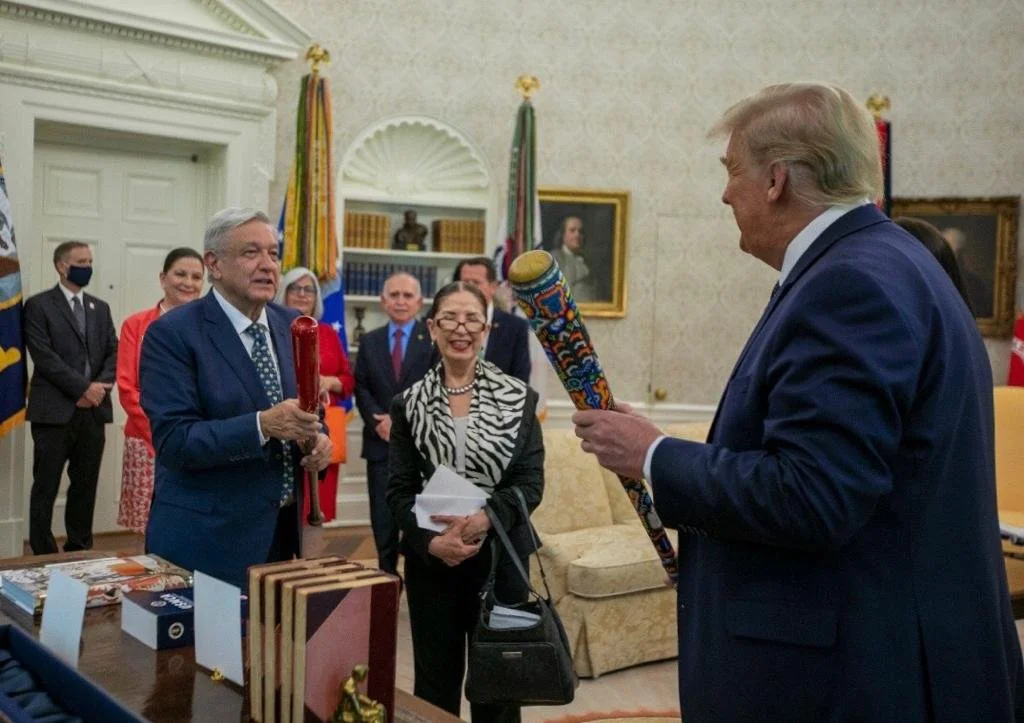
Lilia Rubio (center) with the then-President of Mexico, Andrés Manuel López Obrador (left), and U.S. President Donald Trump (right) during a meeting at the White House in July 2020, in which both leaders exchanged baseball bats.
FROM JALISCO TO UTAH, VIA TIJUANA
Rubio recounts her life story with passion. She tells of a time in Spain when a friend remarked that, watching her walk, he got the impression she came from a family accustomed to moving vigorously through the mountains. She told him he was right.
“My grandparents and great-great-grandparents roamed the mountains wearing huaraches (sandals)—almost barefoot—because back in the village, they couldn't even afford donkeys; or else they used the donkeys to head out to the pastures to work and haul in their crops,” Rubio recalls.
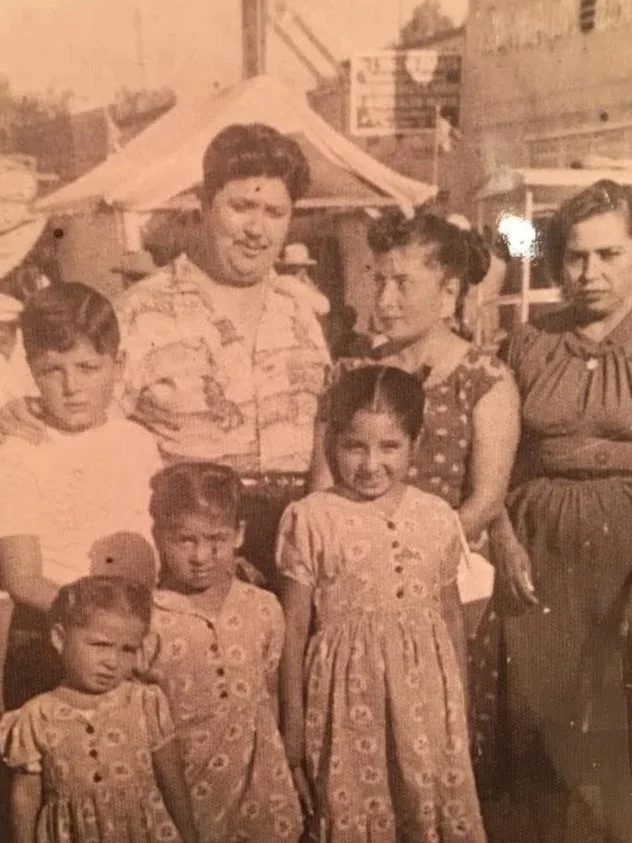
The Rubio family in Tijuana’s “tolerance zone,” where they resided before moving to Utah.
Driven by that same determination, her family migrated to Utah, where her father, José Rubio, eventually came to be recognized for his contributions to the community. Resting on her desk is a posthumous crystal award dedicated to her father, who passed away in 1998.
Her parents—her father and her mother, Felicitas Zamora—first migrated from Jalisco to Tijuana’s “Red Zone.” Her father disliked farm work, so he became a barber instead. Once in Tijuana, he found work at a birria restaurant, and it was there that the rest of the family eventually joined him.
Tijuana was Rubio’s home for the first ten years of her life. “We lived in those wooden shantytowns—some of the poorest neighborhoods imaginable—completely devoid of amenities: no running water, no electricity,” she said. “All sorts of transients drifted into that neighborhood—the poorest of migrants, people with no formal education.”
Through sheer effort, her family opened their own birria restaurant. It was there, Rubio recalls, that Mike Malloy, a Mormon missionary, arrived and introduced her father to the Church of Latter-day Saints.
“And while Dad was prepping the onions and cilantro, the limes and the goat birria, [Malloy] just talked and talked,” says Rubio. Soon after, her father became a Mormon and brought his family into the fold.
Her mother was concerned about the environment in Tijuana; her father, about not having enough income. But their Mormon contacts told them that in Provo, Utah, a local restaurant called El Azteca was looking for a cook. And so, they decided to move.
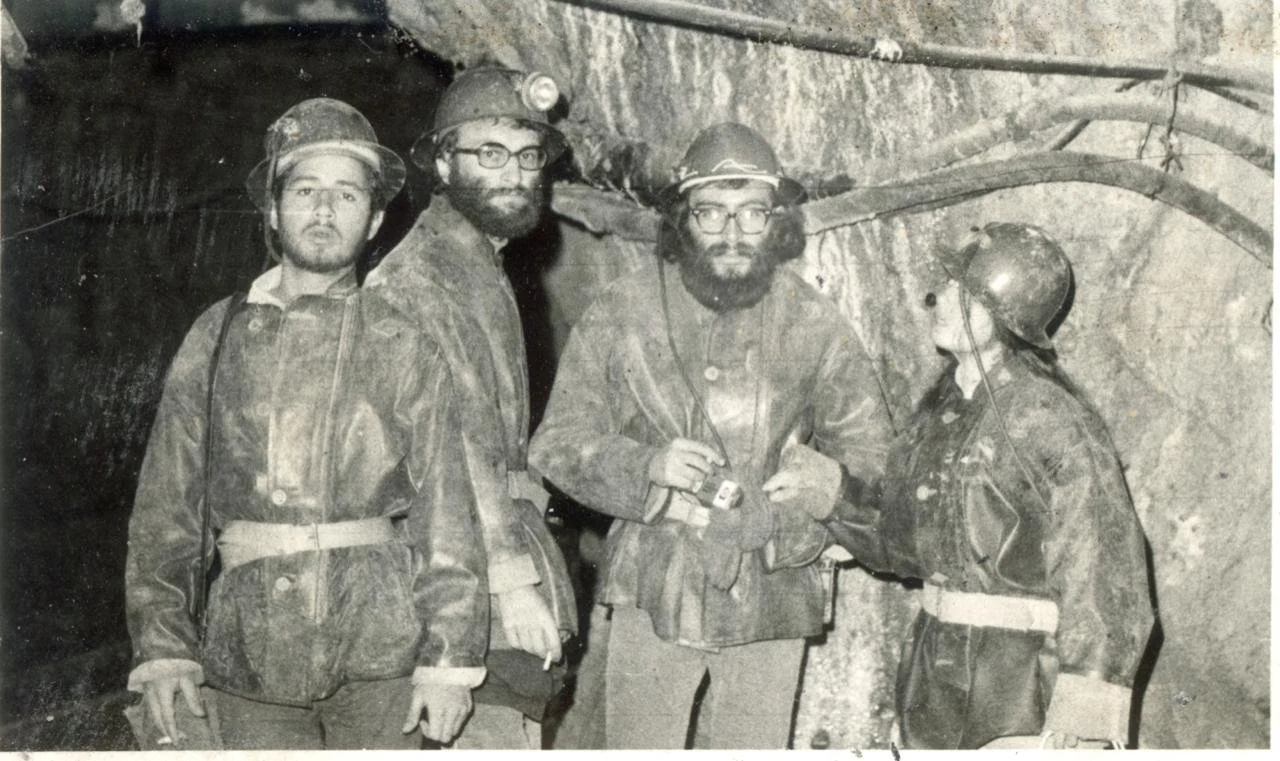
In the early 1970s, Lilia Rubio traveled throughout South America for a year and a half. In the photo, she appears on the right, alongside the Chilean documentary collective Informe, during a film shoot in Bolivia
THE REBELLION OF EL TEATRO CAMPESINO
Her family arrived in Provo. According to Rubio, they were the only Latin American family in town back then.
“The Mormons found it admirable that Mom and Dad—with their four children—had come to a town so far from Mexico to build a new life. We didn’t speak English, we had no money, and our Spanish was that of the peasants from Jalisco,” she explained.
The entire family worked at El Azteca. Lilia started out as a dishwasher, all while attending her new school alongside her sisters and learning English.
As Lilia entered her teenage years, she continued to study and work, yet she grew increasingly restless with her family’s conservatism.
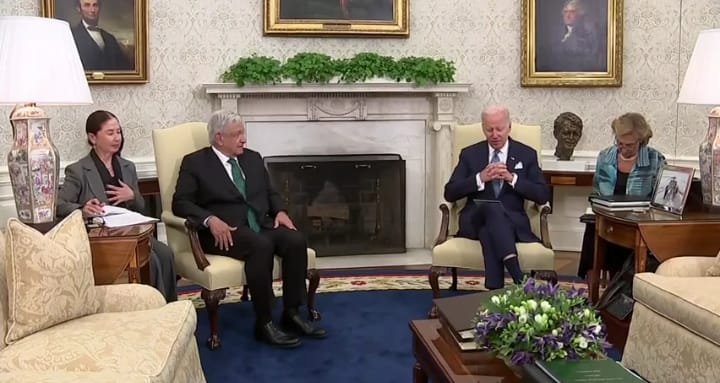
Lilia Rubio (left) seated next to the then-President of Mexico, Andrés Manuel López Obrador, during a meeting with President Joe Biden in Washington in July 2022.
But then, one day—she recalls—a young Chicana woman from the legendary El Teatro Campesino (The Farmworker’s Theater)—founded by playwright and actor Luis Valdez—passed through Provo and turned her life upside down. She told Lilia that their troupe performed in California’s agricultural fields, raising awareness among undocumented farmworkers about their labor rights and the reality of racism.
Lilia had never heard of racism before. “[The young woman] told me that in Utah, we were living in a very blessed bubble, but that in California, Latino communities faced persecution—you could be detained just for speaking Spanish, and people lived in constant fear of immigration raids.”
“That,” she said, “is where my rebellion began.” In Mi Voz, she recounts how she set her plan for independence in motion. Her vehicle for doing so was the theater. She participated in the Mormon community’s theater group, followed by a brief stint in the theater program at the Mexican Social Security Institute (IMSS) in Tijuana.
At the age of 20, in 1971, she struck out on her own, breaking away from her family. She moved to Mexico City, where she taught English to support herself while attending the National School of Dramatic Arts. She left the school after two years to hone her craft through theatrical activism in street and community spaces. This path eventually led her to embark on an adventure—spending a year and a half traveling across South America with a youth-led group dedicated to protest theater, which was later joined by Chilean documentary filmmakers from the Informe collective.
In 1976, Lilia decided to settle down in Mexico. She discovered—quite by chance—that there was a school dedicated to interpretation and translation. Unaware that this was a recognized profession, she enrolled in the Institute for Interpreters and Translators, funding her studies by continuing to teach English.
Thus began her career working for various language interpretation and written translation agencies; today, she works for CM Idiomas. Rubio considers herself the dean of interpreters for presidential teams. Concurrently, for a time, she performed interpretation and journalistic work for The Wall Street Journal and served as a contributor to the culture section of the newspaper La Jornada.
“We are witnessing unprecedented times regarding migration flows worldwide, as well as in the reactions of the United States, European nations, and Latin American countries. But migration is a human right—and who is going to stop it?”
INTERPRETING POWER
While Lilia speaks at length when discussing her personal history, she remains guarded when referring to her employers within the spheres of political and economic power. “I am an active interpreter,” she states. “Confidentiality is key; it is both a contractual and an ethical commitment.”
Recently, Rubio accompanied Sheinbaum on her official trip to the 2026 FIFA World Cup draw held at the Kennedy Center in Washington, D.C. “I was there merely for support; she is perfectly fluent in English,” she notes.
The President has not yet met with Trump. However, the interpreter has seen the U.S. leader on various occasions—such as when he visited Mexico as a candidate for the first time in 2016 to meet with Enrique Peña Nieto. “I was with López Obrador on every trip where he met with Trump,” she says. Among these was the meeting in the Oval Office of the White House in 2020, during which they exchanged baseball bats.
Rubio is concerned about the immigration enforcement measures implemented by the Trump administration. “We must achieve immigration reform; it is necessary. The United States can no longer keep putting it off.”
“We are witnessing unprecedented times regarding migration flows worldwide, as well as in the reactions of the United States, European nations, and Latin American countries. But migrating is a human right—and who is going to stop it?,” says the interpreter.
—

Laura Castellanos is an independent Mexican journalist based in Mexico. She writes about topics related to social transgression and resistance. She is the author of six books and has received the Maria Moors Cabot Award from the Columbia University Graduate School of Journalism in New York (2022) and the Latin American Investigative Journalism Award from the Latin American Conference of Investigative Journalism (COLPIN, 2016), among other commendations. She was previously with Radio Bilingüe in Fresno, California, and at the now-defunct feminist publication Doblejornada of the Mexican newspaper La Jornada. Her work has appeared in various media outlets, including the Dominga insert of the Milenio newspaper, the Spanish-language opinion page of the Washington Post, Aristegui Noticias, Gatopardo magazine, and the dailies El Universal and Reforma. @lcastellanosmx
Rodrigo Cervantes es un periodista bilingüe y estratega en comunicación galardonado y con amplia experiencia en Estados Unidos y México, entre otros países. Ha colaborado con medios como NPR, CNN, The Los Angeles Times y la BBC. Dirigió el buró en México de KJZZ, fundando la primera oficina internacional de una emisora de radio pública estadounidense. Fue editor general de la sección de Negocios de El Norte, parte de Grupo Reforma, uno de los principales grupos editoriales de México. En Georgia, EE.UU., dirigió la redacción de MundoHispánico, la publicación latina más antigua y de mayor circulación en el estado en ese entonces, perteneciente a The Atlanta Journal-Constitution. Su trabajo ha sido reconocido con premios Murrow de la RTDNA y José Martí de la Asociación Nacional de Publicaciones Hispanas (NAHP). Fue secretario de la Asociación Nacional de Periodistas Hispanos (NAHJ) y actualmente es co-director editorial de palabra, así como profesor adjunto en la Escuela de Periodismo y Comunicación W. Cronkite de la Universidad Estatal de Arizona (ASU). @RODCERVANTES