
The Lemon Grove Incident: How a Mexican American Community Fought School Segregation and Won

The Lemon Grove Incident Mural by artist Mario Chacón, depicting children and newspaper headlines from the landmark 1931 school desegregation case. Photo by Anne Stapleton
Nearly a century after a brave group of parents organized a boycott and filed a landmark lawsuit in San Diego County, their children, grandchildren, and community reflect on the legacy of a historic victory for educational equity.
Clic aquí para leer en español.
By Saida Pagán, @SaidaPagan
In 1930, Lemon Grove, California, in San Diego County, was a small, but thriving agricultural town with a growing Mexican American population. Many of the Latino families there sent their children to the Lemon Grove School with the hope that education would mean a brighter future.
“The children got along – the Mexican kids, the Anglo kids and so on,” said Roberto Alvarez Jr., professor emeritus of Ethnic Studies at the University of California, San Diego, and son of the lead plaintiff in the Lemon Grove desegregation lawsuit.
The school had more than 165 first through eighth-graders, about half of whom were of Mexican origin. While many were born in the U.S. and spoke English, some students had recently arrived and were just learning the language. For a while things were fine, but as the population of newcomers grew, the differences in culture and language proved challenging. To add to the frustration, the toilets in the outhouses had backed up more than once that school year.
The Parent-Teacher Association started receiving complaints, so in the summer of 1930, the school’s board of trustees met and considered a request to build a separate school for Mexican children. Overcrowding and the lack of English proficiency were among the main concerns. With the endorsement of the chamber of commerce, the Lemon Grove School Board voted to build a school just for Mexican students on their side of town.
Separate schools for Asian, Native American and Mexican children were not uncommon in California in 1930. Nevertheless, the Board anticipated some resistance, and decided not to tell the parents until after the holidays.
subscribe to palabra’s newsletter
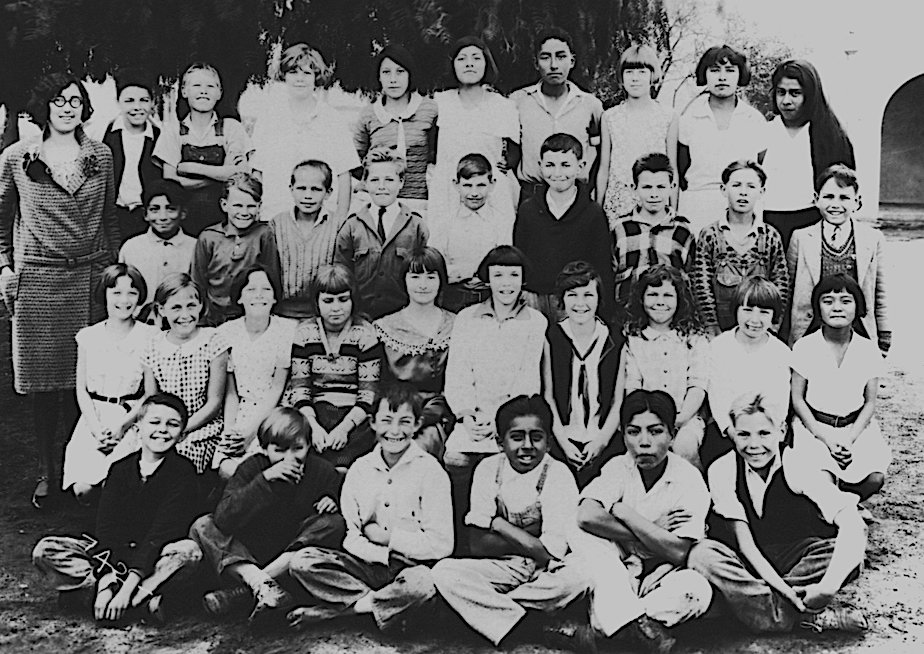
Students at Lemon Grove School in 1929. Photo by Lemon Grove Historical Society
“During the Depression you had the rise of a very anti-Mexican repatriation program…so there was a deep racial tone to the policy,” suggested John E. Valdez, professor emeritus of Chicano Studies at Palomar College in an interview with Hispanic Link Media Network.
Construction began in the fall, and little by little the word got out.
The late Elisa Gomez was a student at Lemon Grove School in 1931. In an interview for the Lemon Grove Oral History Project several years ago, she recalled the concerns of the Latino parents. “They wanted to separate the Mexicans from the Whites. So they made one big room, and they wanted to put all the Mexican children in that one room,” Gomez said.

Students at Lemon Grove School in the late 1920s. Photo by Joe Smith
Principal Jerome Green was hesitant about the plan and tried to have a questionnaire passed around to determine if the parents would actually send their children to the new school. But one angry family member reportedly tore up the document before the others could respond.
“They were quite shocked and very unhappy,” noted Valdez whose aunts attended Lemon Grove that semester.
The parents quickly mobilized, and formed the Lemon Grove Neighbors Committee or El Comité de los Vecinos de Lemon Grove. They were led by Juan González, a feisty, well-educated former labor organizer, who had several children at the school, and had worked with Pancho Villa during the Mexican Revolution. Ramona Castellanos, Roberto Alvarez Sr.’s mother, was the other leader.
“They wanted the best for their children,” Valdez explained.
“Mexican Student Strike”
Many of the parents were angry that their kids would be forced to attend what they viewed as a school so inferior that they nicknamed it la caballeriza or horse stable. They were also concerned that the hastily built school would have a lower quality of education and fewer amenities.
Soon the idea of a school boycott emerged.
Support the voices of independent journalists.
|
But not everyone agreed. Some parents pointed out that it was against the law not to send children to school. Others feared losing their jobs in an era when thousands were being deported during the Mexican Repatriation campaign.
On January 5, 1931, the first day back after the Christmas holiday, some parents kept their children home, while a few others sent their sons and daughters to school.
Decades later former students recalled that the principal, acting at the direction of the school board, allowed all the other children to go to their classrooms, but told the Latino students he would escort them to their new school when he returned.
“My parents said to go home,” said Judy Beltrán Smith in a recent interview with The San Diego Union-Tribune. At 106 years old, Smith is believed to be the last surviving student present on that day.
The other children also returned home as per their parents’ instructions.
What happened next was what the press dubbed what followed as the “Mexican Student Strike.”
“The community…[had written] to La Opinión, which at the time was the largest Spanish-[Language] newspaper in the U.S.,” said Alvarez Jr. in discussing the media coverage the parents sought to support their cause.
In the weeks that followed, the vast majority of Mexican parents continued to refuse to send their kids to class, and some even enrolled them in other districts where relatives lived.
Then the group filed a complaint with the Mexican consulate. The consul was reportedly sympathetic to their cause, and helped them hire lawyer Fred Noon, who was known to both the consulate and to González, who had used his services in the past.
As news of the student strike continued to make headlines, the parents stepped up their activism, holding rummage sales, selling food and requesting donations to pay for legal costs.
Finally, the parents filed their case. It was assigned to Superior Court Judge Claud L. Chambers in February 1931, and filed on behalf of Roberto Alvarez and more than 70 other Mexican American children. The parents accused the board of attempting racial segregation by separating children of Mexican ancestry – many of whom were American citizens.
Roberto Alvarez – then 12 years old, was chosen as lead plaintiff.
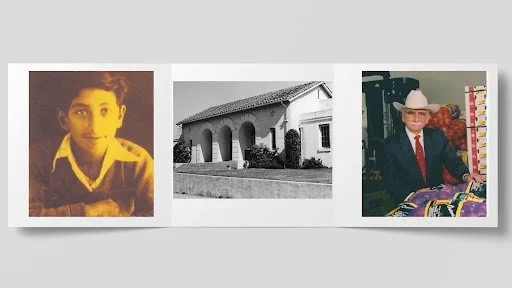
Roberto Alvarez at age 12, Lemon Grove School in 1924, and Roberto Alvarez in adulthood. Photos: Roberto Alvarez Jr. and Lemon Grove Historical Society
“He was very good in school and he spoke really good English,” said Alvarez Jr. in explaining why his father was selected. “One of the arguments was that the students couldn’t speak English, and that all were behind. That’s the reason they chose him.”
Roberto took the stand, and testified that he spoke fluent English, liked school, and was not behind in his studies. About ten other students also testified similarly.
Hispanic and White
The Lemon Grove Trustees denied all allegations and insisted the separate facility was designed to benefit the Latino children. They said it would allow them to receive special attention and be closer to home.
But the plaintiffs pointed out that only two teachers would be assigned to the school and that one of the instructors did not have a lot of experience.
By the end of March 1931, Judge Chambers ruled in favor of the parents. California law at the time considered people of Mexican descent to be Caucasian based on Hispanic heritage. The law prohibited the segregation of White students.
But perhaps more importantly, the judge stated that a few students could be separated to improve their education, but not the whole group. The judge ruled that complete separation would deny them the daily presence of American children which would be necessary to learn English.
The Lemon Grove School District was ordered to admit the Mexican American students to their original school in order to receive an equal education. The school board was also ordered to pay the plaintiffs’court fees.
Within a week, the kids were back at school.
“I know that when that happened, my grandmother was very excited to be reunited with her classmates,” said Joaquin Gracida, Judy Beltrán Smith’s grandson. “She was just happy to see her friends again.”
After the legal proceedings were over, the children were advised not to discuss the matter publicly. It wasn’t until the late 1970s that Alvarez Jr. found out about the case while interviewing family members for academic research.
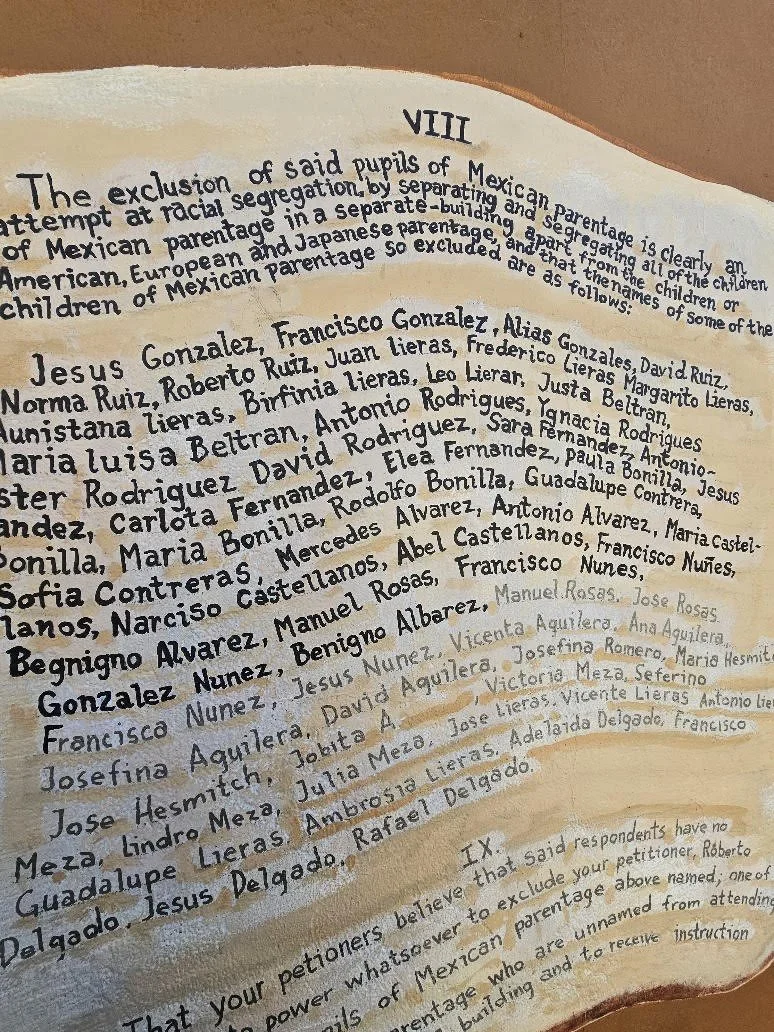
Names of Children on Lemon Grove Incident Mural by artist Mario Chacón. Photo by Anne Stapleton
Since then, he has written extensively about the Lemon Grove Incident, delivering several talks about the case, which is one of the first public school desegregation cases involving multiple Latino children in the United States. At times he was accompanied by his dad, Roberto Alvarez Sr. who went on to lead a productive life, graduating from high school, becoming a bookkeeper while in the Navy and starting a large international produce distribution business.
“It was the community that had the courage to stand up, organize, fight back and know what their rights were for their children,” Alvarez Jr. said.
Numerous articles and books have since been written about the Lemon Grove Incident. The local historical societies house exhibits and there was even a KPBS docudrama produced about the events.
The city has declared March 30th, Lemon Grove Incident Day, and the entire month of March is now recognized as Lemon Grove Incident Month.
“It was the community that had the courage to stand up, organize, fight back and know what their rights were for their children.”
— Roberto Alvarez Jr., professor emeritus of Ethnic Studies at the University of California
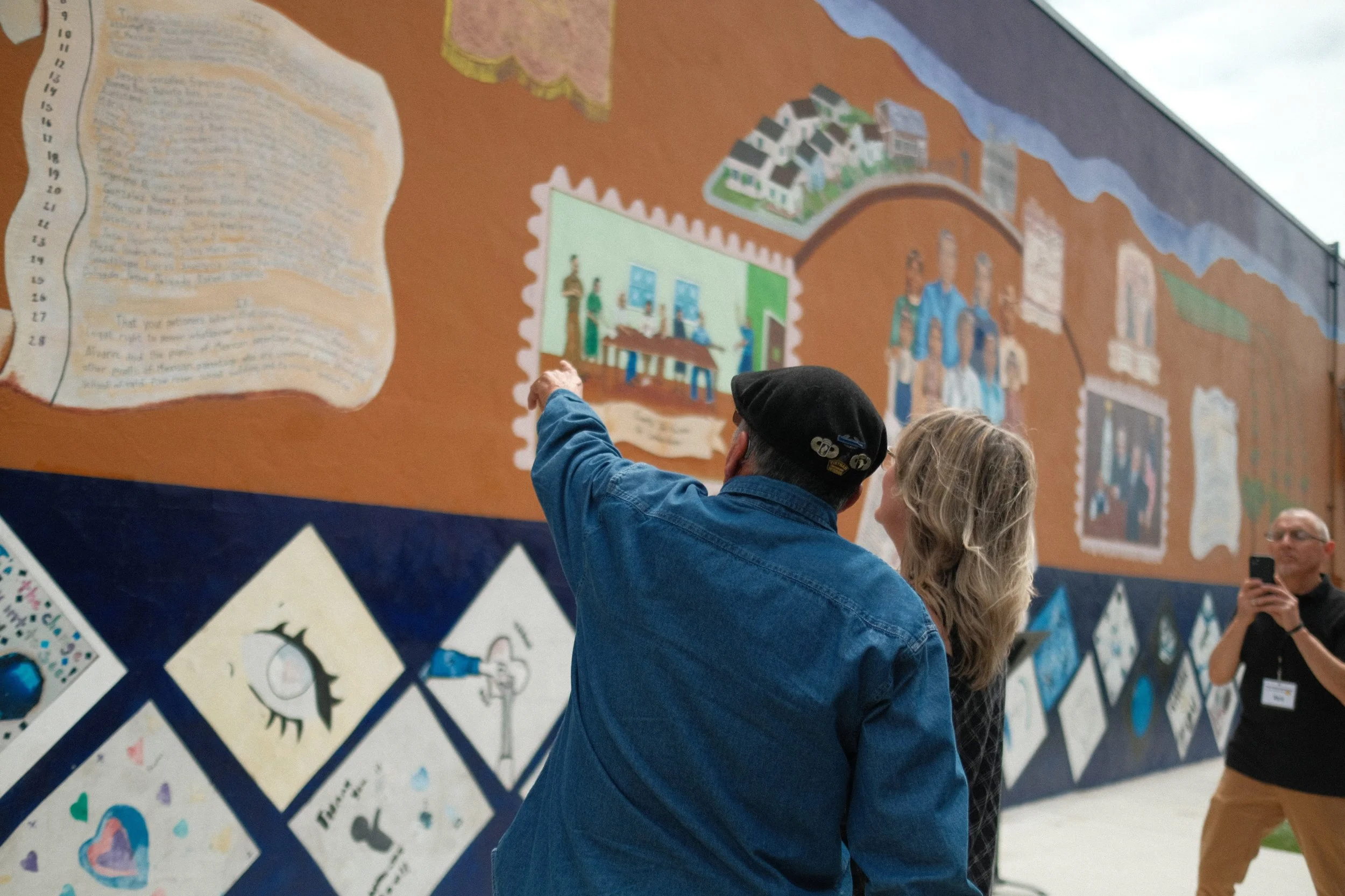
Visitors comment on the Lemon Grove Incident Mural by artist Mario Chacón. Photo by Anne Stapleton
Today the local school district has a student population that is 70% Latino and fully supports bilingualism. In 2021, the board adopted a resolution supporting educational equity.
“The school community is aware of the Lemon Grove incident. It is part of who we are – the history that we tell,” said Marianna Vinson, the district superintendent.
And in honor of his memory, the Lemon Grove Academy Middle School named one of its auditoriums after Roberto Alvarez Sr. who died in 2003 at the age of 84.
The case is also part of the school’s curriculum for all third graders.
“They’re very interested and very proud, too,” said Laura Hook, president of the Lemon Grove Historical Society, which regularly sponsors an essay competition about the case.
And as a very public tribute to the families that chose to stand up for what they believed in, a 70-foot mural depicting the events surrounding the Lemon Grove incident was completed a few years ago. With loving detail, it pays homage to the children and their families whose quest for equality nearly 100 years ago continues to earn respect and inspire the next generation.
“When I give tours of the mural, people are very encouraged to see what the community back in 1931 was standing up against, and how much courage they had,” said Ann Stapleton, who has been very involved in showcasing the mural. “It’s inspiring to them and it’s needed today.”
—

Saida Rodríguez Pagán is an award-winning Los Angeles-based journalist celebrating her sixth year as a contributor for palabra. Since 2020, Saida’s articles on the entertainment industry – and her television reports and documentaries — have been nominated for 22 Los Angeles Press Club-sponsored awards, Golden Mike Awards, Emmy Awards, or National Association of Telecommunications Officers and Advisors regional and national awards. In 2024, Saida earned a certificate with highest honors in Journalism and News Writing from the New York University School of Professional Studies. She also holds a master’s degree with distinction in Strategic Communication from National University, and completed her undergraduate studies in Communication at the City University of New York. Saida has had a decades-long career in journalism and in addition to her work for palabra, Saida is also a correspondent for Local News Pasadena and a contributor for Writer’s Digest. Her articles have also appeared in Well + Good, L.A. Parent and Red Cross Talks among other publications. Her acclaimed TV show, American Stories with Saida Pagan, is now in its third season, and can be seen on The Arroyo Channel in Southern California as well as on YouTube and various streaming platforms. @SaidaPagan