
The Hidden (and Human) Cost of DACA Processing Delays
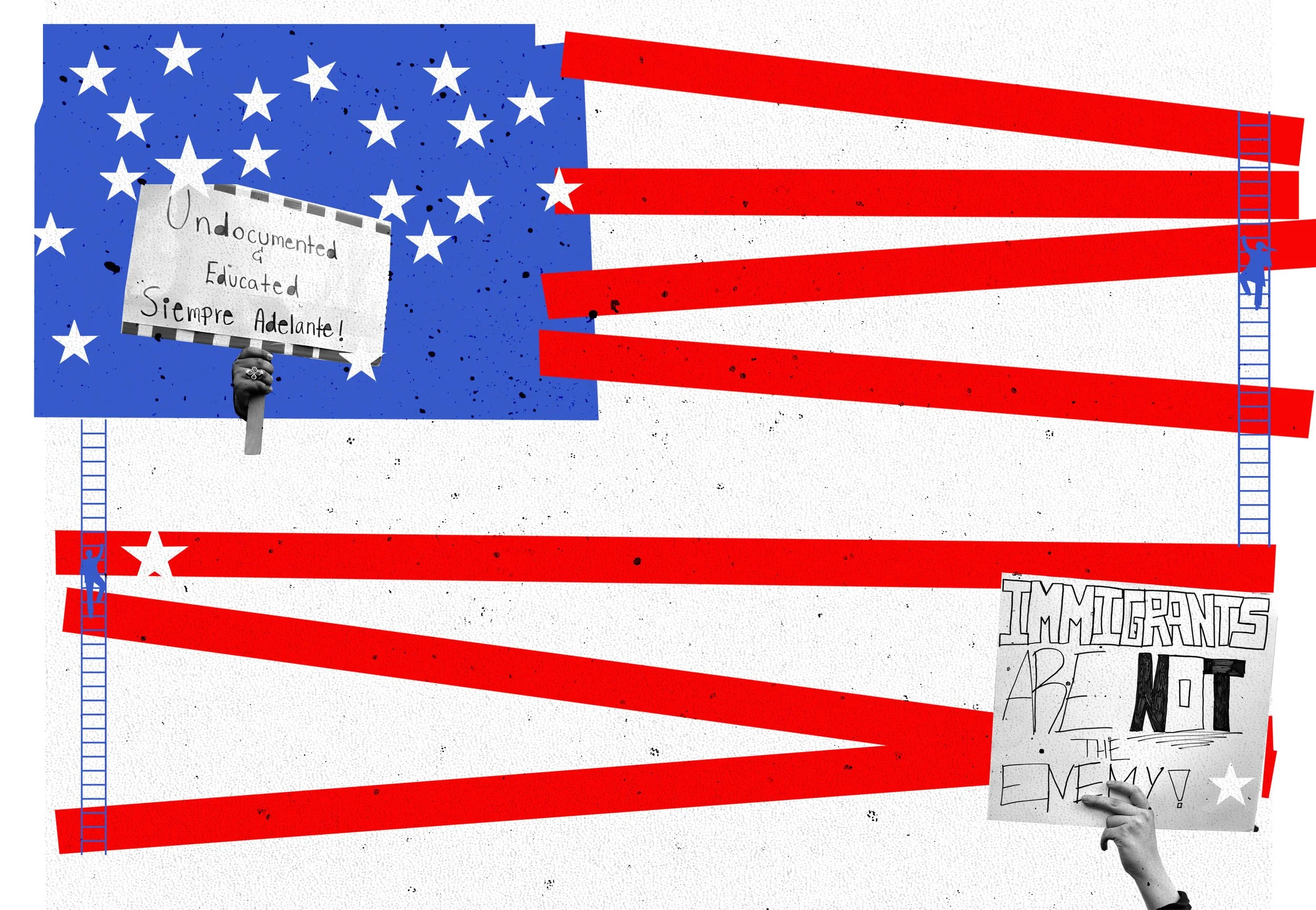
Photo illustrations by Susana Sanchez-Young
As DACA Renewals Stall, Dreamers Find Support in Online Lifelines, and Face the Possibility of Unemployment, Detention, and Deportation.
Clic para leer en español.
Words by Yesica Balderrama, @yesica_bald
When M.S. gets behind the wheel in North Carolina, she stays on interstates and main roads, where she knows she is less likely to be stopped by a police officer. The news from around the country about Immigration and Customs Enforcement (ICE) raids and the arrests of undocumented immigrants has made her apprehensive about traveling, but staying at home is not an option.
She and her husband, both undocumented, have to drive daily to transport goods in box trucks from warehouses to supermarkets. M.S. spoke on the condition of anonymity, using only her initials, to protect their safety. Driving is a risk they take to continue living their life as normally as possible. The family-owned business is their sole source of income.
M.S.’s work permit and license expired at the beginning of April 2026, so she has been driving without it. Whether today could become the day a traffic stop changes her life, she does not know.
SUBSCRIBE TO PALABRA’S NEWSLETTER
“Of course, there is a fear that I'll get stopped, so I'm trying not to drive as much,” M.S. said to palabra. “I’m trying to go ways that are safer, like not going to a checkpoint. If I get stopped, then it's gonna be an issue. It’s fear of being near any type of cop or anybody that involves having to show documentation.”
M.S. is a 35-year-old DACA recipient from Veracruz, Mexico. Her parents brought her to this country at the age of 10. She is one of many “Dreamers” waiting for the U.S. Citizenship and Immigration Services (USCIS) to process her paperwork renewal.
Listen to M.S. in her own words
Deferred Action for Childhood Arrivals (DACA) gave undocumented youth, brought to the country as children, the right to stay and work legally. There are about 505,940 recipients who have to renew their paperwork every two years. For thousands of Dreamers, an expired work permit means much more than paperwork. They are concerned about their livelihoods and about being detained by ICE.
Support the voices of independent journalists.
|
Recipients and activists interviewed by palabra attributed the delays to USCIS requiring recipients to submit their biometrics in person as part of the vetting process. Many Dreamers haven’t submitted biometrics since their first application.
“So far, it has affected me because you have to have a valid ID to do some transactions. We have vehicles that are pretty much all under my name,” M.S. said. Last year, I had to have heart surgery. I don't have insurance at this moment because I don't have a valid ID. That’s gonna be delayed now.”
M.S. is confident she will be approved, but she doesn’t know how long it will take. Renewals are taking longer to process, and many are losing their jobs and benefits due to expired employment authorization cards. The majority of cases are resolved within four months, whereas in the past, it took about two to six weeks. It is a difficult waiting game for most.
M.S. tosses and turns at night, and her anxiety grows each passing day. Reading to her toddler and preparing food for her family in the evenings helps her cope. She could lose everything she has worked to build if her work permit renewal is not approved— her home, her family, and her business. She is thinking about how to plan for an unknown future.
“My husband and I have considered the possibility of returning to our country in the future. We are currently researching real estate opportunities and taking online courses in preparation, particularly if we are unable to resolve our immigration status within the next five years or so,” M.S. explained.
M.S. has never been arrested, has submitted her paperwork early every time, and her family paid $12,000 in taxes. She might have to sell her business or move to a state that is more immigrant-friendly if her renewal takes longer than expected.
“I'm doing all the right things that anybody who wants to be legal is doing. There's nothing I can do to fix it,” she said.
Recipients Create Solidarity Online
In Facebook groups with tens of thousands of members, Dreamers find community, mutual aid, emotional support, and advice. They inform each other and allies about their experiences, such as how long their work permit renewals are taking, and they recommend each other ways to make ends meet.
They are apprehensive about performing any activity that may disclose their undocumented status. Dreamers report relying on self-employment, working off the books, or using their savings for income. The names of the groups and their members are not shown to protect them.



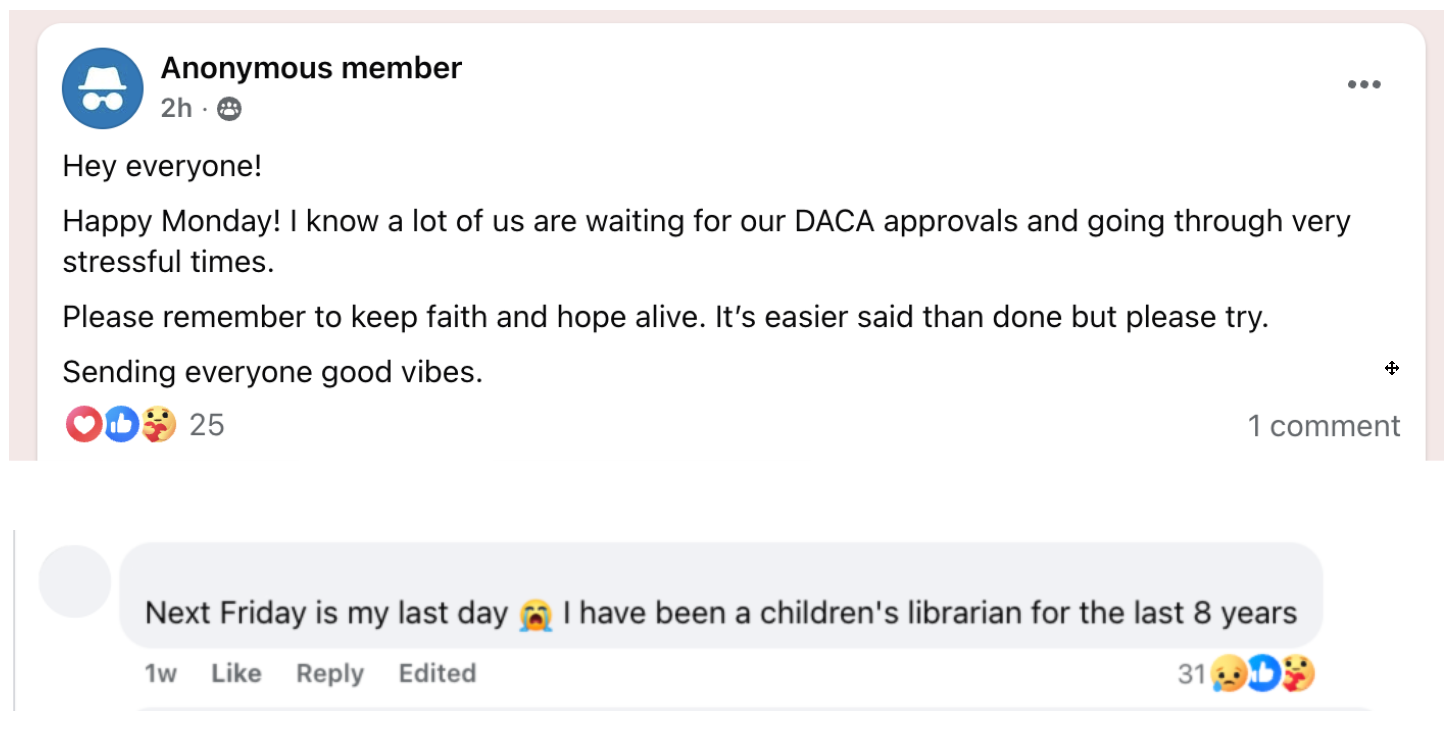
Screen shots provided by Yesica Balderrama
Listen to M.S. in her own words
“There are a lot of consequences that come from losing DACA, even for a short period of time. It has been really challenging to see the uncertainty that has always been present with DACA. People report having to plan their lives 2 years at a time because you really don't know what's going to happen when there's a change in administration,” said Ignacia Rodriguez Kmec, a policy counsel at the National Immigration Law Center (NILC) and lawyer.
Kmec advises Dreamers to submit their renewals 120 days before the expiration date, to save any changes to their case status, and to learn about their rights in the workplace. She encourages them to share their stories with a member of Congress to pressure them to take action on behalf of the DACA community.
It’s a Waiting Game
The first thing Christian Vasquez does at his computer at 7 a.m. every morning is check his paperwork status. Later at his work desk, he will check again during lunch and once more at the end of the day. He doesn’t understand why his paperwork is taking longer to process than others who submitted after him.
It has been over four months since he filed for his renewal. He has reached out to USCIS and contacted his congressional representative without any luck.
Vasquez’s work permit expired in May. He is a 31-year-old technician from Durango, Mexico, living in Los Angeles. If he does not get his updated physical card soon, he could be unemployed. His manager is letting him continue working at his discretion.
“My regional manager wrote me a letter, like why I was important to the company and why they should consider renewing my work permit faster, that way I don't lose my job. I submitted the letter as supporting evidence to see if that helped,” said Vasquez, “They won't let me continue working even if I show the approval letter because they actually want the physical copy of the work authorization.”
Research showed about 92% DACA recipients are employed and pay an estimated $2.1 billion annually to Social Security and Medicare — programs that benefit all Americans.
While Vasquez waits, he is prepared to work off the books if necessary. In his 20s, Vasquez was an undocumented employee in Compton, California. The small warehouse didn’t have windows or air conditioning. He and his two coworkers drank water to stay hydrated in the stuffy, hot, cluttered room where they rearranged and stocked lightbulbs, cords, electrical panels, and other supplies. It paid him about half of what he is earning now.
“I'm just letting things be because I'm not trying to be all stressed or anxious. I feel like a lot of people, once they lose their work permit, it shuts their minds off, and they don't know what to do because they have only worked with DACA,” Vasquez explained.
Since its creation in 2012, thousands have entered the workforce and made significant contributions to the economy. Research showed about 92% are employed and pay an estimated $2.1 billion annually to Social Security and Medicare-– programs that benefit all Americans. The figures demonstrate potential financial losses if DACA were to be rescinded.
What Nonprofits Are Doing
“This should not be happening. DACA recipients have been renewing their status for the better part of a decade so they're well known to the government. The idea that they have to go through extreme vetting is kind of absurd,” said Juliana Macedo do Nascimento, deputy director of advocacy and campaigns at United We Dream (UWD).
“We haven't heard that there is any kind of technical issue or processing issue that explains why these delays are happening,” explained Kmec.
Activists from UWD and the NILC are advocating on behalf of Dreamers. UWD is a large grassroots immigration nonprofit run by youth. It has defended DACA from the many legal challenges it has faced over the years. At first it attributed the slower processing times to stricter vetting practices and holds on to the paperwork of Dreamers from countries labeled at-risk. According to USCIS September 2025 data, roughly 3,000 recipients have their applications on hold and will have to undergo a thorough vetting process.
“We know that the administration has a mass deportation agenda. When you see them slow walking applications so that people lose their jobs and their protection, it leaves them vulnerable. That's what we're concerned about — that this administration is slow walking renewals on purpose so that they can be detained,” said Nascimento.
Listen to M.S. in her own words
UWD and other immigration nonprofits are tracking who is being arrested and sharing the cases online. Last year 261 recipients were detained, and 86 were deported, according to a letter by the Department of Homeland Security (DHS). The rising numbers have Dreamers and advocates concerned about the future of DACA.
The organization recently collaborated with politicians to encourage the government to perform oversight and accountability over slow processing times. In April, Rep. Jesús “Chuy” García (D-Ill.) and Rep. Lou Correa (D-Calif.) led a letter signed by 86 members sent to the DHS and USCIS urging them to address the delays. The previous month Sen. Dick Durbin (D-Ill.) and Sen. Catherine Cortez Masto (D-Nev.) wrote a letter with similar requests. They have not received a response.
Palabra reached out to USCIS to ask why DACA renewals are being delayed and what the government is doing to improve processing times. Here is an excerpt of USCIS’s comments: “USCIS is safeguarding the American people by more thoroughly screening and vetting all aliens. DACA does not confer any form of legal status in this country. Illegal aliens claiming to be recipients of DACA are not automatically protected from deportation.”
“DACA was not enough. It was supposed to be, and now it's outdated,” said Nascimento.
—

Yesica Balderrama is a first-generation bilingual Mexican journalist based in New York City. Her work has appeared in WNYC, NPR, The Associated Press, The Los Angeles Times, PEN America, Guernica, and others. @yesica_bald!