Navigating the Legal Minefield: A Reporter's Guide to Newsgathering Laws
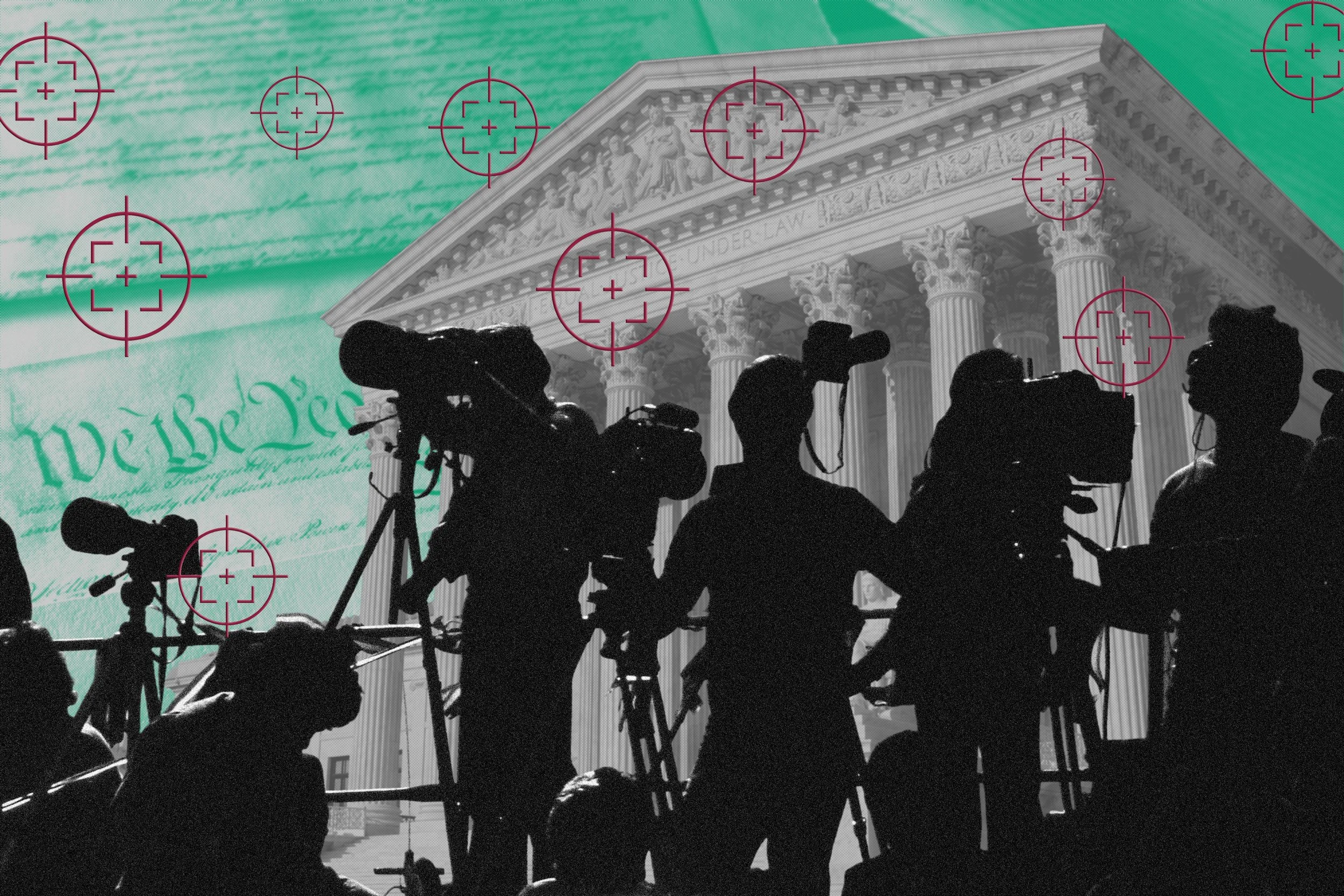
Photo illustration by Yunuen Bonaparte for palabra
Journalists have broad rights to publish — but far fewer to investigate. Here’s a map of the legal tripwires, from hidden cameras to border searches.
A journalist sits in a police car during a ride-along, camera in hand, as officers prepare to execute a search warrant on a private home. Across town, an investigative reporter, posing as a patient, walks into a medical clinic with a hidden camera to document allegedly unethical practices. At the border, another journalist watches as a customs officer scrolls through five years of her social media history. Each of these scenarios represents a potential legal minefield where the noble pursuit of truth can collide with laws protecting property, privacy, and national security.
Jeff Hermes, Deputy Director of the New York-based Media Law Center, recently addressed these complex issues in a comprehensive Zoom presentation sponsored by palabra with NAHJ members that delved into the often contradictory legal landscape facing today's journalists. His central message was clear: while the First Amendment protects the publication of news, it offers surprisingly limited protection for the gathering of that news. Reporters operate in a world where generally applicable laws — those that apply equally to everyone — can and do restrict newsgathering activities, even when the resulting reporting serves clear public interests.
The First Amendment Paradox: Protection Without Special Access
The legal foundation of American journalism contains a fundamental tension that Hermes emphasized repeatedly. In the landmark 1972 case of Branzburg v. Hayes, the U.S. Supreme Court established that “the First Amendment does not guarantee the press a constitutional right of special access to information not available to the public generally.” This principle means that being a journalist does not confer a legal right to enter private property, access government records, or attend events closed to ordinary citizens.
Yet, as Hermes noted, the Court has simultaneously acknowledged that some protection for gathering news must exist because “you can't report the news if you can't gather the news.” This paradox creates what legal scholars call a “negative right” — the press is free from government interference in publishing, but doesn't have affirmative rights to access information.
The high court further clarified this principle in Cohen v. Cowles Media Co. (1991), ruling that “generally applicable laws do not offend the First Amendment simply because their enforcement against the press has incidental effects on its ability to gather and report the news.” This means journalists can be held liable for violating laws against trespassing, intrusion, or breach of promise, even when doing so in pursuit of a story.
Trespassing and Undercover Reporting: Where Consent is Everything
When journalists physically enter spaces to gather news, trespass law becomes their primary concern. Hermes explained that trespassing occurs when someone enters another's property without consent or exceeds the scope of granted permission. The critical distinction often lies in how consent is obtained and whether the reporter's actions stay within its boundaries.
Two pivotal cases illustrate this delicate balance:
Desnick v. ABC (1995): ABC reporters posed as patients to investigate an eye care clinic allegedly performing unnecessary cataract surgeries. The Seventh Circuit Court ruled this was not trespassing because the reporters entered areas open to the public and did nothing beyond what ordinary patients would do.
Food Lion v. Capital Cities/ABC (1999): ABC journalists obtained jobs at Food Lion grocery stores using fabricated applications, then used hidden cameras in employee-only areas to document unsafe food handling. The Fourth Circuit Court found them liable for trespass because they exceeded their authority as employees by gathering news instead of conducting company business.
Hermes stressed that consent must come from someone with authority to grant it, and it can be revoked at any time. A landlord generally cannot authorize entry into a leased apartment, nor can police automatically bring journalists along on searches of private homes — the Supreme Court has held such “ride-alongs” violate Fourth Amendment rights.
Intrusion Upon Seclusion: When Privacy Trumps Newsgathering
Even when journalists don't physically trespass, they can violate privacy through intrusion upon seclusion. This legal action prohibits intruding — physically or otherwise — upon another's solitude or private affairs in a way that would be “highly offensive to a reasonable person.” Unlike trespass, intrusion doesn't require physical entry; it can occur through telephoto lenses, drones, or enhanced listening devices.
The 1998 California case Shulman v. Group W Productions provides a nuanced example. A news crew filmed a rescue operation following a serious car accident:
Recording on the open highway was permissible (public space)
Recording audio of the trapped victim raised intrusion concerns (no meaningful consent possible)
Recording inside the medical helicopter potentially constituted intrusion (comparable to a hospital room)
Hermes noted that consent remains a defense to intrusion claims, but the analysis is highly fact-specific. Using drones to capture footage on private property can constitute intrusion, though some state laws include newsworthiness exemptions.
Press Passes and Government Property: Symbols of Permission, Not Rights
Many journalists view press passes as tickets to access, but Hermes offered a sobering correction: “There is no First Amendment right to obtain a press pass.” These credentials are simply symbols of permission to enter places not open to the public. Different government agencies set their own rules for issuing passes with almost no standardization.
However, once issued, revocation cannot be retaliatory for First Amendment activity. The recent incident involving the Associated Press — which lost White House access after refusing to use the term "Gulf of America" instead of “Gulf of Mexico”— illustrates this principle, though the legal fight continues. Revocations must also follow due process, providing notice and an opportunity to be heard.
Access to government property follows similar principles: There's generally no right to access government offices, military bases, or detention facilities. The exception is “dedicated public forums” like sidewalks and public parks that have traditionally been open to public expression, though even these spaces can have reasonable time, place, and manner restrictions.
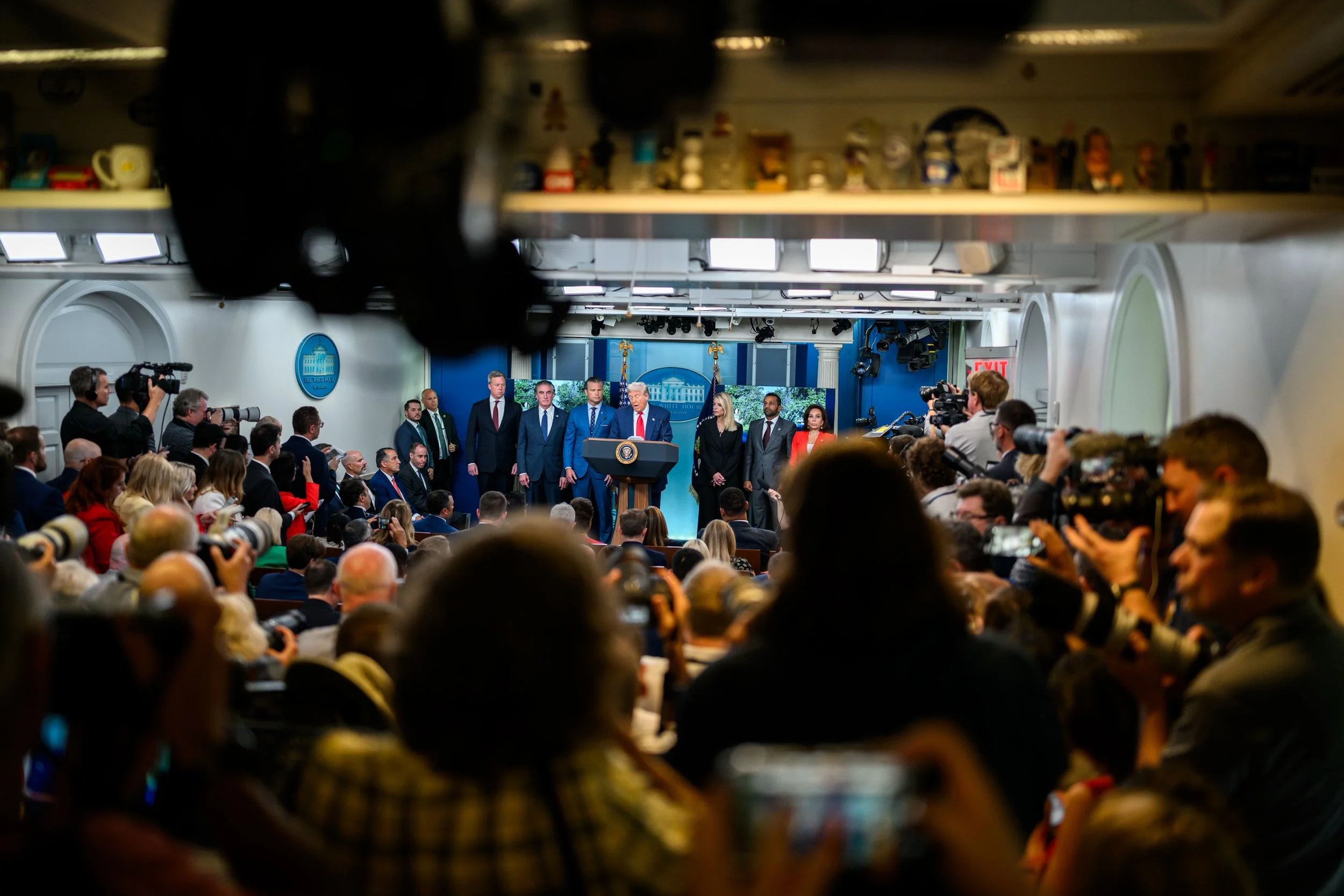
President Trump holds a press conference on Monday, August 11, 2025, in the James S. Brady Press Briefing Room. Photo by Daniel Torok/courtesy of the White House
Courtroom and Immigration Proceedings: Contrasting Access Rights
Access to judicial proceedings reveals another layer of complexity in newsgathering law:
Criminal trials: Since the 1980 Richmond Newspapers v. Virginia decision, there has been a First Amendment right to attend criminal trials, which can only be closed for exceptionally good reasons.
Civil proceedings: Access rights are more limited and vary by jurisdiction, often balanced against party and witness interests.
Immigration hearings: These operate differently as executive branch proceedings (U.S. Department of Justice) rather than judicial. While federal regulations make them presumptively open, immigration judges have significant discretion to limit access for various reasons, including space limitations, witness protection, or national security.
Hermes emphasized that courtroom sketching may be restricted if it could identify protected witnesses, and advised artists to seek permission from the judge beforehand.
Recording Laws and Digital Tools: Navigating Consent Requirements
The tools journalists use to gather information come with their own legal constraints. Eavesdropping or wiretap laws vary significantly by state, falling into two main categories:
Jurisdiction Type |
Consent Requirement |
Example States |
|---|---|---|
One-Party Consent |
Only one participant must consent |
New York, Florida |
All-Party Consent |
All participants must consent |
California, New Jersey |
Hermes offered practical advice: When recording conversations involving parties in multiple states, “always obey the most restrictive state” to avoid liability.
For drone journalism, Federal Aviation Administration regulations require registration, remote ID signals, and compliance with airspace restrictions. State laws may add additional privacy protections. Meanwhile, digital trespass represents an emerging frontier where unauthorized computer access can lead to liability similar to physical trespass.
Interacting with Law Enforcement: Rights and Realities on the Ground
A significant portion of Hermes' presentation addressed journalist-police interactions, particularly in the context of immigration enforcement. Eight federal circuits have recognized a First Amendment right to record police performing public duties, with the First Circuit even overriding state laws against secret audio recording in this context.
However, this right has limits: it cannot interfere with police duties or override trespass restrictions. Inside police stations or detention centers, facility-specific rules may prohibit recording.
Three key legal protections apply during encounters:
First Amendment: Protects against retaliation for journalistic activity (though proving discriminatory intent is challenging)
Fourth Amendment: Requires warrants for searching devices, though "border exceptions" create gray areas
Privacy Protection Act (1980): Generally requires subpoenas rather than warrants for journalists' work product, with exceptions for situations involving crime or imminent danger
Hermes addressed the particular vulnerabilities at border crossings, where the Privacy Protection Act explicitly doesn't apply to customs searches. He noted one court has questioned whether higher scrutiny should apply to journalists at borders, but this remains unsettled law.
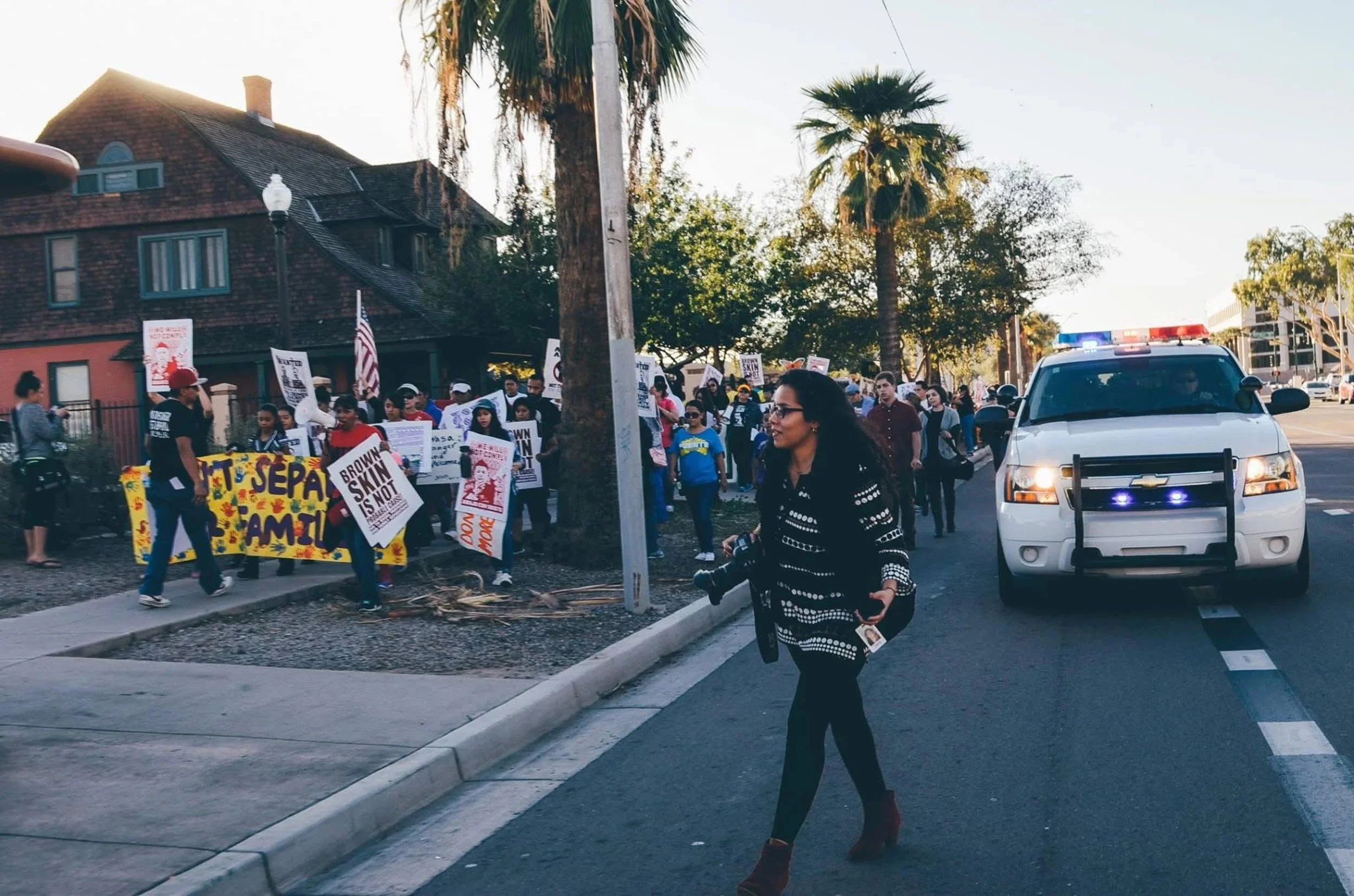
Journalists Laura Gómez Rodríguez reporting on a march in downtown Phoenix, Arizona, organized by local immigrants’ rights groups in November 2015. From the palabra story “The Burden of Bearing Witness.” Photo by Diego Lozano, courtesy of Laura Gómez Rodríguez
The Human Element: Practical Safeguards for Journalists
Recognizing that “not all law enforcement officers are going to acknowledge your legal rights,” Hermes offered practical advice for journalists:
Obey police orders in the field even while asserting rights
Visibly identify as press with badges or clothing
Document everything with cloud backups in case devices are seized
Travel in groups with distributed equipment and check-in plans
Carry contact information for both media and immigration attorneys
For freelancers without organizational support, Hermes emphasized the importance of creating their own safety infrastructure, including having someone not at the event who knows their location and expected check-in times.
Confidential Sources and Legal Gray Areas
The presentation concluded with what Hermes called "an interesting piece" about confidential sources. He delivered sobering news: “There is no general First Amendment right for a reporter to refuse to disclose their sources.” While some states have shield laws, these may not apply in federal courts dealing with federal agents.
When courts compel source disclosure, they typically use a balancing test weighing government need against newsgathering impact. Hermes warned that promising confidentiality might require journalists to risk contempt charges, making advance legal consultation essential through resources like the Reporters Committee for Freedom of the Press hotline.
Support the voices of independent journalists.
|
The Essential Tension
Throughout his presentation, Jeff Hermes returned to the fundamental tension at the heart of newsgathering law: The press must gather information to fulfill its democratic function, yet enjoys no special immunity from laws protecting property, privacy, and promises. This creates what he called “a very real concern” in American journalism — the legal vulnerability inherent in pursuing truth.
The legal landscape continues evolving, with new challenges emerging around digital tools, border screenings, and source protection. For journalists, navigating this terrain requires both knowledge of legal principles and practical judgment about when to push boundaries and when to exercise caution. As one questioner noted regarding distance from police operations, there are few bright-line rules, only context-dependent analyses of what constitutes interference.
In an era when, as the ACLU notes, journalists face increasing pressure and the "fear of a censored press" feels increasingly real, understanding these legal parameters becomes not just a matter of avoiding liability, but of preserving the journalistic function itself. The tools exist — from First Amendment principles to practical safeguards — but their application requires the careful judgment that has always distinguished responsible journalism from mere information gathering.
Watch the full webinar below.
—

Patricia Guadalupe, raised in Puerto Rico, is a bilingual multimedia journalist based in Washington, D.C., and is the co-managing editor of palabra. She has been covering the capital for both English- and Spanish-language media outlets since the mid-1990s and previously worked as a reporter in New York City. She’s been an editor at Hispanic Link News Service, a reporter at WTOP Radio (CBS Washington affiliate), a contributing reporter for CBS Radio network, and has written for NBC News.com and Latino Magazine, among others. She is a graduate of Michigan State University and has a Master’s degree from the Graduate School of Political Management at George Washington University. She is the former president of the Washington, D.C., chapter of NAHJ and is an adjunct professor at American University in the nation’s capital and the Washington semester program of Florida International University. @PatriciagDC