
Latinos Are Uniting Through Digital Fundraisers To Free Those Detained By ICE
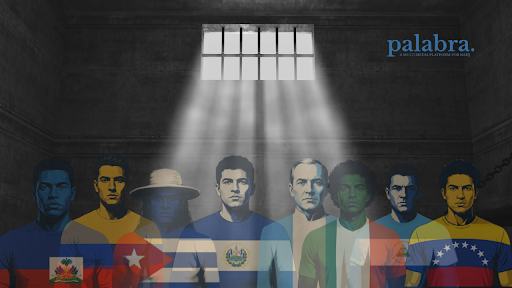
Art by Dayimar Ayala Altuve
Legal and court fees, plus potential bails exceed the economic capacity of migrant families, who depend on their community’s solidarity with "contributions" or "collections" to try to bring their loved ones back home.
Clic aquí para leer en español.
By Dayimar Ayala Altuve
Editing and translation by Rodrigo Cervantes
“Two police officers stopped me. They asked me to turn off my phone and they’re taking me to jail.” Those were the last words Pablo* heard from his son, Ramón, that early morning in May 2026. What followed was a flood of expenses impossible to sustain alone.
*Note: The names of those who provided their testimonies
for this story preferred to remain anonymous,
as some still face legal proceedings after being released on bail.
All names presented are only a reference.
Pablo is Venezuelan, has lived in Florida for 10 years, and is awaiting the resolution of his asylum request. He and his family had to spend $15,000 in bail; 17 days of anguish, anxiety and uncertainty; and a change in family dynamics to bring Ramón back.
A fundraising campaign promoted by for Ramón’s family was somehow successful, as other Venezuelans and fellow country people within the United States donated. The remaining family expenses had to be covered with personal loans and more work.
subscribe to palabra’s newsletter
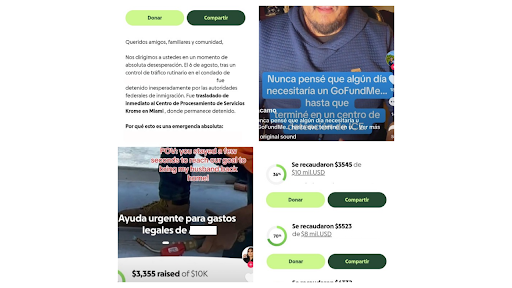
Collage: GoFoundMe; Jacamo07 on TikTok.
Support the voices of independent journalists.
|
In January 2026, Telemundo News documented several cases where some people had to rely on the solidarity of anyone willing to help cover essential expenses, such as food or utility payments, especially when the main provider is detained for immigration reasons.
A simple Google search shows that Pablo and Ramón are not the only ones who have had to request financial assistance online to pay for lawyers, expenses within detention centers (phone calls, entertainment tablets, court appearance fees, documentation costs, etc.) and possible bails. There are dozens of families.
“Help my brother come home.” “Help us reunite our family.” “I was detained by ICE and I need your help.” These are some of the phrases accompanying fundraising campaigns on platforms like GoFundMe. Similar messages are circulating on WhatsApp, asking people not to share the request publicly and to donate via Zelle.
For arrest expenses, requests for help range from $5,000 to $30,000, although support is also sought in other ways, from social media outreach to even prayers.
According to Pablo, Ramón has no criminal record, works in the systems department of a telecommunications company, and was arrested after his car’s tire got flat, causing him to crash into a highway fence. A police car arrived minutes later, supposedly to "help" him, but upon seeing his license, they noticed it was "temporary" and that he had a pending immigration process (an asylum application).
A second patrol car arrived. That`s when they allowed him to make that emergency call to his father. Then, they put his hands behind his back, handcuffed him, and took him away. On the other end of the phone, the family was left with more questions than answers.
“That afternoon he called us and confirmed that he was being detained. He told us that they were pressuring him to sign a self-deportation document, and that it hurt him to breathe. They took him to the hospital, doctors confirmed he had two broken ribs, and despite the recommendation that he should remain hospitalized for at least two days, the authorities returned him to the detention center. They kept transferring him from one jail to another, and with each transfer, the time allotted for his hearing was canceled, making the process begin again over and over,” Pablo said.
“Each person detained seems to be a business, because these detention centers are run by private companies; so it's a business in terms of food, clothing, the time they spend there, the ways they can communicate. There are many realities in all of this. It's not possible that you give me permission to be in your country, grant me a work permit, a Social Security Number, require me to pay taxes, and then go and detain me,” he pointed out.
Legal options for immigrants in the United States have been dwindling, with delays in asylum approvals and suspension of immigration protections for citizens of certain countries, including Venezuela, like he Temporary Protected Status (TPS) and the humanitarian parole.
HELP IS COMING FROM ALL SIDES
In Doral, also in Florida, Venezuelan Pedro also got arrested in August 2026 on his way to his job as an assistant at an event planning agency. A police car stopped his vehicle and, after asking for his license, inquired if he had TPS, asylum, or any other immigration status. Then they took him to jail. Same story: a hard worker with no criminal record, but with a pending immigration case.
His family launched a fundraising campaign that reached 30% of its goal in the first few hours. “People might not think it’s right to ask for money for something like this, but we don’t have the money. We all work day to day, and this completely changes things, because he (Pedro) helped us with expenses,” explained María, his mother, a Venezuelan woman who, like her son, is on the list of those affected by the suspension of TPS. María has been waiting for four years on the resolution for her pending asylum application.
“We’re doing this campaign because we want people to know that every little bit helps; not everything can be solved with money, but it does help,” María added.
Carola, a Venezuelan who lives in Mexico, donated in May 2026 to the campaign of a friend's husband, also Venezuelan. “I helped them because I truly believe it’s something that, before this whole wave of persecution of migrants, not many people had faced. People have this misconception that those of us who are outside of our country have a lot of money, and that’s not the case for most of us. My friend missed work shifts to meet with her husband’s lawyers, they had to cut back on food, and of course, they couldn’t help their family in Venezuela. So why not help her? It was the right thing to do, and I did,” Carola said.
Fundraising campaigns often have a viral effect, as word spreads among family members in their countries of origin through online migrant groups and social media. It's Latinos supporting other Latinos in an unprecedented situation, generally a response to an "emergency" fueled by fear stemming from numerous reports of cruel treatment and inhumane conditions in detention U.S. immigration detention centers.
“People might not think it’s right to ask for money for something like this, but we don’t have the money. We all work day to day, and this completely changes things, because he helped us with expenses.”
—María, a Venezuelan mother
“EXPENSES ARRIVE OVERNIGHT”
A TikTok user with the name of Jacamo07 explained in a video that he never thought he would need a fundraising campaign, until he was detained by ICE. The young Nicaraguan says he creates “educational, not legal” content. In his video, he explains that it's not just the lawyer's fee, but also “the cost of calls, fares at the police station, document shipping, and many other expenses that arrive overnight."
According to information collected by palabra from affected people, a lawyer can charge between $4,000 and $18,000; bail ranges from $1,500 to over $20,000 if the court considers there to be a "flight risk"; an estimated $100 per week for communication and phone bills; $100 or more in copies and taxes, and a long etcetera.
ICE data shows that until July 2026 (latest data available) 74,082 non-citizens have been arrested. The New York Times reported that the number of arrests for immigration reasons is "record-high", noting that it appears that ICE "is closer to meeting its goal of 2,000 arrests per day".
There are public cases of Cubans, Ecuadorians, Mexicans and more.
Claudia Curiel, Hispanic spokesperson for GoFundMe, said that the platform does not currently have data on collections related to immigration detentions.
Almost all the campaigns offer details on how the funds will be used and provide context for the case, but few families dare to speak publicly about the process because they feel persecuted and targeted by the authorities. They feel that exposure could make them the next immigration target. At least six families declined to give their testimony for this report due to “fear” or “following the advice of their lawyers.”
—
Dayimar Ayala Altuve is a social communicator graduated from the Santa Rosa Catholic University in Caracas, Venezuela. She specializes in public opinion and received training in disability issues from the Center for Disability Studies at Monteávila University, also in Caracas. She is the founder of Di-capacidad, the first digital information platform about disabilities in Venezuela, which focuses on sharing inspiring stories, highlighting progress for the disability community, and promoting media literacy. She is involved in social volunteer work and has worked for news outlets such as Univision Noticias and La Razón in Spain, among others.