
‘How can I remain resilient?’: A child care provider urges changes to America’s immigration policies

Photos courtesy of Yanet Martínez. Illustration by Acento Story Tank.
Fear of immigration raids and uncertainty impact Yanet Martinez, a grandmother and promotora who advocates for policies that protect families and the child care system.
Clic aquí para leer en español.
By Ashley Álvarez, @ashleymalvarez1
Edited by Sonia Osorio
This past May, Yanet Martinez was making her usual walk to the bus stop to pick up two of her grandchildren from school when she witnessed federal immigration officers detaining people near MacArthur Park in Los Angeles.
That day, the bus was her escape from immigration officers.
“I don’t even know how I saw the bus. The door was open and I got in,” said Martinez.
“It’s different when you see it on television or in the news. The most cruel and impactful moment was seeing it in person, living it. Seeing how they were throwing people on the ground and seeing one of [the agents] walk towards me,” said Martinez. “I felt out of body. I felt numb.”
Yanet Martinez immigrated to the United States from El Salvador 17 years ago, and currently holds a humanitarian visa. Now based in Los Angeles, she has an in-home catering business, cleans houses for extra income, and provides free child care for her grandchildren, a form of care known as Family, Friend, and Neighbor care that is license-exempt in California.
Martinez is also a promotora with various community-based organizations and volunteers at a local hospital.
subscribe to Palabra’s newsletter
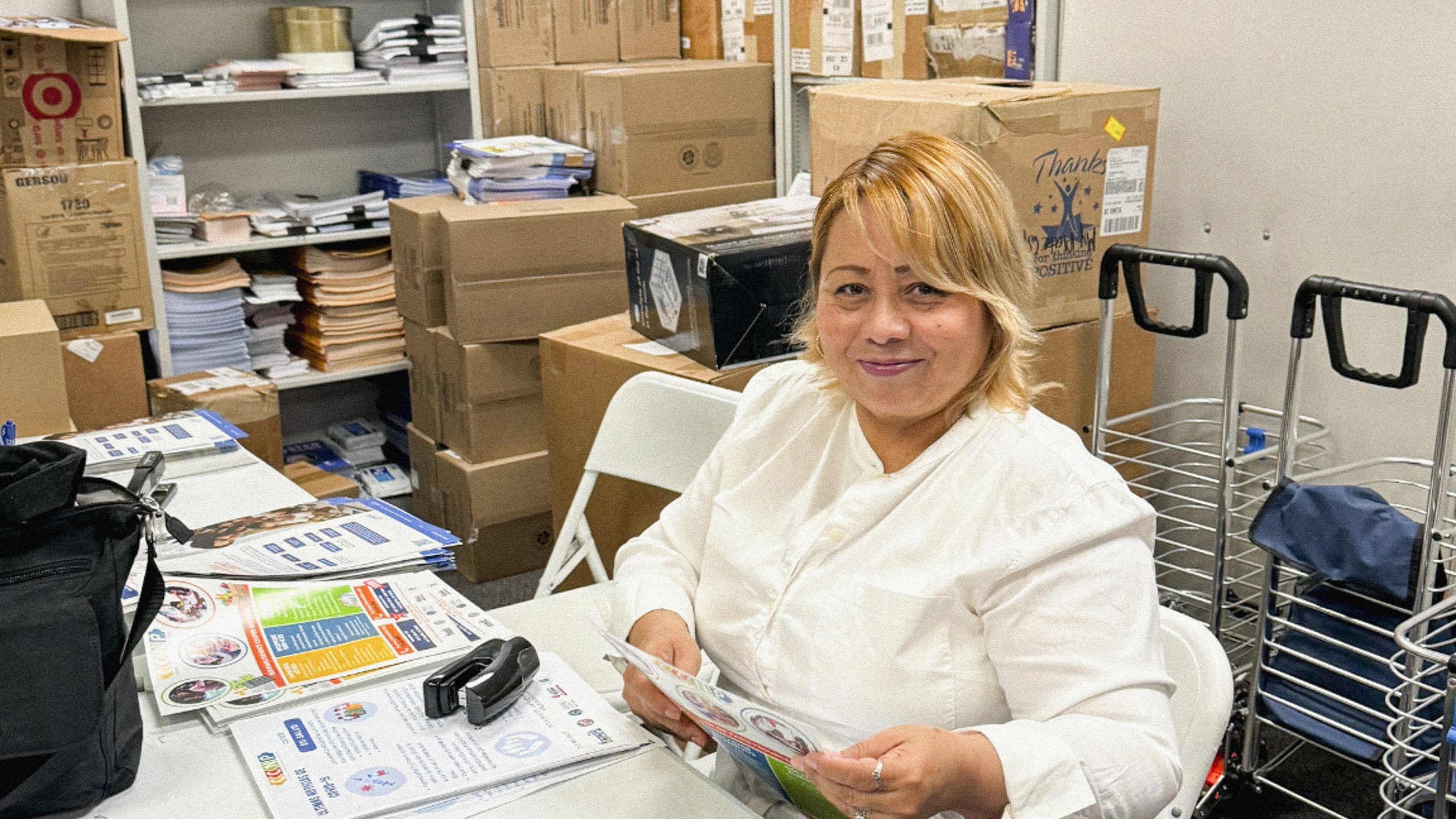
Yanet Martinez, a promotora in Los Angeles, prepares informational material. Photo courtesy of Yanet Martínez.
“I always have this fear,” said Martinez. “But I care about the community, and that is what makes me strong enough to make that decision to face [my fear].”
Since President Trump returned to office in January 2025, immigration enforcement has intensified, backed by unprecedented funding increases. In the first year alone of the president’s second term, his administration has enacted over 500 policy actions related to immigration enforcement, surpassing the total number across the four years of his first term.
Martinez is not the only one who has experienced the impact of immigration policy shifts. The RAPID Survey, an ongoing study based out of Stanford University that regularly captures the experiences of adults who care for children, found that about one in three (36%) immigrant and nonimmigrant parents, as well as child care providers (30%), noticed the impacts of immigration enforcement activities in their community. More than half of those child care providers indicated a reduced sense of safety, belonging, and unity in the community.
“The impacts of immigration enforcement on the adults in young children’s lives extend beyond immigrants. This is affecting children, families, and the early care and education workforce,” said Dr. Philip Fisher, Faculty Director of the Stanford Center on Early Childhood. “This is creating conditions that lead the adults who care for children to feel unsafe.”
Shifts in immigration enforcement have also affected school attendance and academic performance. In interviews with 34 parents from Latino families of mixed immigration status in Chicago and Charlotte, researchers at the Urban Institute found that nearly half said their children had missed school out of fear of immigration enforcement activities. The interviews were conducted in mid-2026, and the findings were published on October 16.
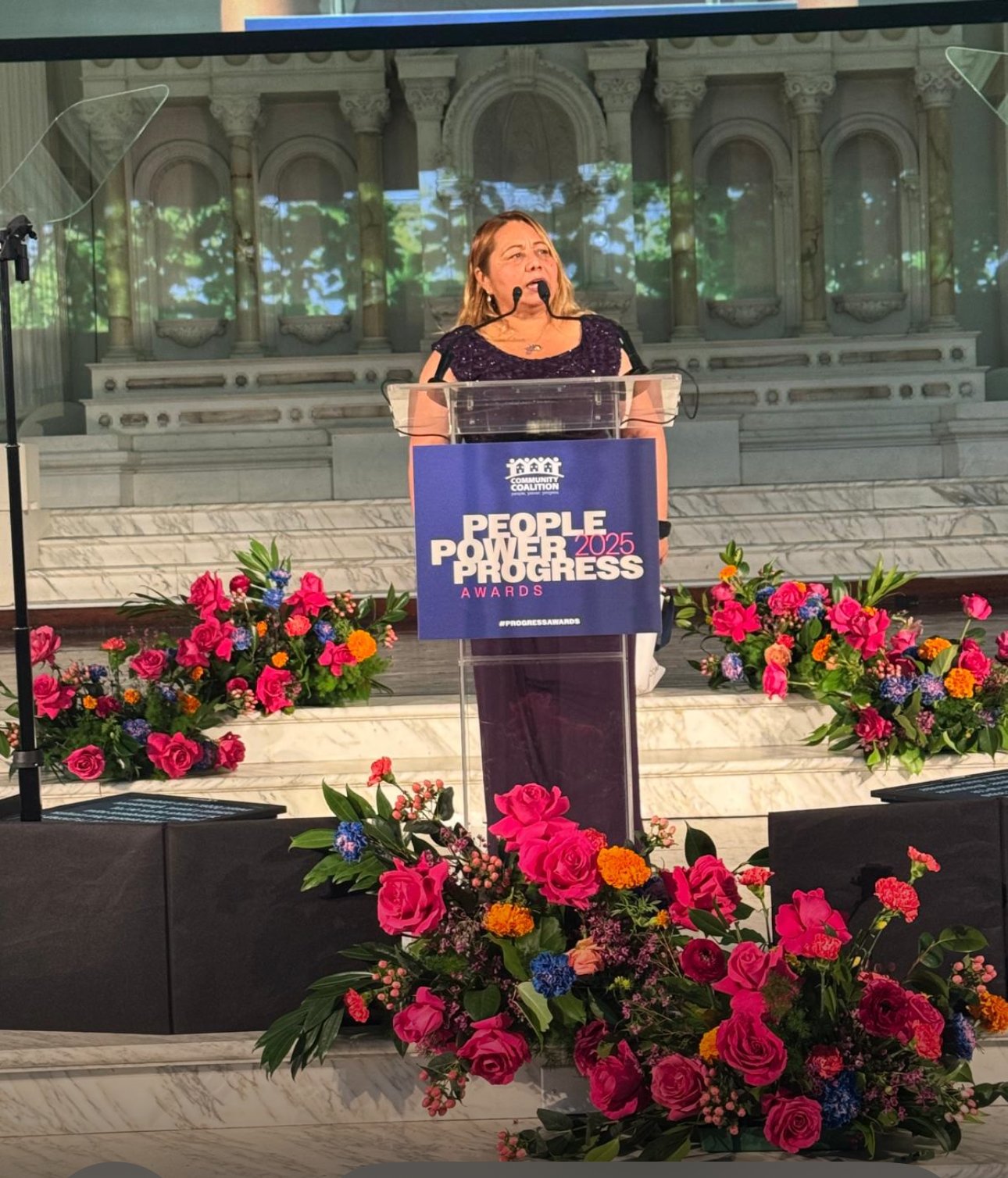
Yanet Martinez speaks at a community event. Photo courtesy of Yanet Martínez.
Apoya las voces de periodistas independientes.
|
Martinez was one of five child care providers from California, Colorado, Illinois, and Texas who shared how their everyday lives have been impacted by shifting immigration policies under the current presidential administration. Their stories provided glimpses into how policies impact day-to-day caregiving. Originally, six providers were to be featured, with one opting out before publication due to fear.
One in five child care providers and elementary school teachers in the U.S. identifies as an immigrant, according to The Hechinger Report, citing data from the ScienceDirect platform.
Therefore, “these negative effects on child care and maternal employment intensify following President Trump’s inauguration in early 2025, when ICE activity increased dramatically,” explains a study by economists Chris Herbst and Erdal Tekin
The researchers compared the number of immigrant women working in child care before and after the increase in ICE operations. Between February and July 2024, an average of 327,000 immigrant women worked in this sector each month.
“By comparing that figure with the same period in 2025, the economists estimated that the doubling of ICE arrests was associated with a reduction of approximately 39,000 immigrant women workers in the sector,” according to the study.
This loss of labor further exacerbates the challenges facing a sector whose workforce already faces significant difficulties, according to the Center for the Study of Child Care Employment.
Community uncertainty and TPS
For Martinez, political uncertainty loomed over the new school year. In between dropping off and picking up her grandchildren at school, she learned that the Temporary Protected Status (TPS) designation for El Salvador was slated to expire September 9, 2026.
While Martinez does not have TPS, she became worried about the impact the policy shift would have on the community. Los Angeles has the largest Salvadoran population outside El Salvador, making the city particularly vulnerable to disruptions in community well-being and workforce stability if TPS designation is rescinded.
On September 9, the federal government issued an update online: “An announcement on El Salvador’s TPS will be made at the appropriate time. Until such announcement is made, Salvadoran individuals present in the U.S. under TPS retain protection including work authorization.”
“[Advocates] are working to extend TPS, but the uncertainty is already here. It’s hard for people who’ve already been let go from their jobs,” said Martinez. “A lot of people have already gone back to El Salvador because of fear… Just yesterday, a friend called me who went back. She’s disappointed, devastated.”
As of the article’s publication, TPS designation for El Salvador has not been officially terminated, nor has it been renewed. This leaves approximately 170,000 Salvadorans with TPS wondering, every day, if today is the day the announcement is made.
“Despite how difficult economically, emotionally, everything has been… how can I remain resilient?” said Martinez, who answered her own question. “Faith, hope, and all the ways I give the best of myself. But I also need policies.”
Immigration policies have exacerbated mental health concerns for immigrant and nonimmigrant families, and disrupted local economies such as that of Los Angeles. They have impacted the lives of people like Martínez, who pick up their grandchildren from school in fear.

Martínez shares information about the elections. Courtesy of Yanet Martínez.
Helping engage voters in the community
“In these moments, children feel a lot of uncertainty, instability,” said Martinez. “Before being elected, [political candidates] promise this and that, but when the time comes, they don’t fulfill their promises and they turn a blind eye. They should honor their promises to provide resources, whether in mental health- which is most pressing right now- or financially to parents.”
As part of her work as a promotora, Martinez engages in a range of community outreach activities, including helping to inform residents on how to exercise their right to vote, distributing basic needs resources like food, and advocating for human rights with local elected officials. “[Voters should] study well, investigate more, so they can elect future politicians [who will] respect human dignity, so we aren’t treated worse than trash, because we’re people.”
“The data are a way to listen to parents and to adults in the lives of young children directly, and hear what their concerns are. For anyone who cares about the wellbeing of young children, these data can play a role in the decision-making they’re engaged in,” said Dr. Fisher.
Martinez ended our conversation paraphrasing Dolores Huerta’s iconic phrase: “Together sí se puede.”
Reporting for this article was supported by New America’s Better Life Lab Story Fellowship. This reporting follows an article first published by The 74. Martinez’s quotes were self-translated from Spanish.
—

Ashley Álvarez is an early care and elementary education policy expert and writer. Born and raised in Los Angeles, Álvarez earned her M.Ed. in Education Policy and Analysis with a concentration in Early Childhood at the Harvard Graduate School of Education. She earned her B.A. in Sociology and Educational Studies at Harvard College.