
How A Mariachi Family Is Conquering NYC and Beyond
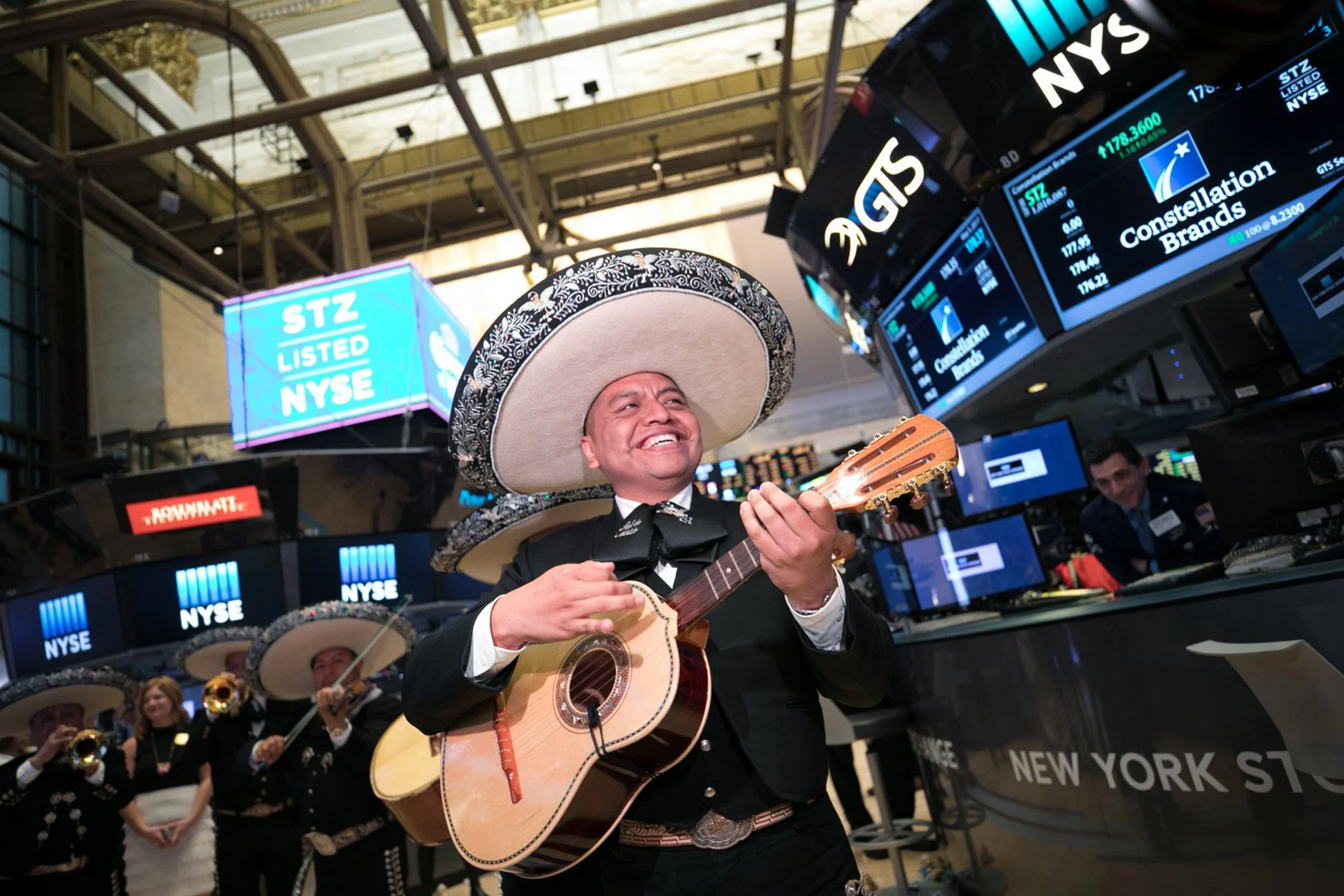
Ramon Ponce Jr. performs with Mariachi Real de México at the New York Stock Exchange for the 5 de Mayo Closing Bell Celebrations in 2020. Photo courtesy of Mariachi Real de México
A band founded by a father and son has been key to the rise of Mexican culture and music in the Big Apple, and seeks to share traditional Mexican music with generations to come.
Haga clic aquí para leer este reportaje en español.


Though Ramon Ponce can’t pinpoint when he started singing, his talent for it won him first place in a contest when he was five years old. This was decades ago in the capital city of Puebla, Mexico, where he was born into a family of musicians on both sides. They lived close to Plaza Santa Inés, where mariachi musicians like his father, Ramon Sr., would spend the day playing for prospective clients who, if impressed, would hire them by the hour.
“We could always hear mariachi music from the house,” Ramon Jr. said.
There were also the many family gatherings where, inevitably, the night would end with people picking up their instruments to play and sing together—something they still do to this day in New York City. Music has always been in their lives.
As Ramon Jr. says often: “It’s like drinking water for us.”
After Ramon and his father moved to New York City, they created what has become for many one of the most renowned mariachi companies in the U.S.: Mariachi Real de México. Over their almost 35-year career, they have played at countless restaurants, birthday parties, and weddings — including Bruce Springsteen’s New Jersey birthday rodeo party several years in a row, Henry Kissinger’s ninetieth, and at the Little Island inauguration.
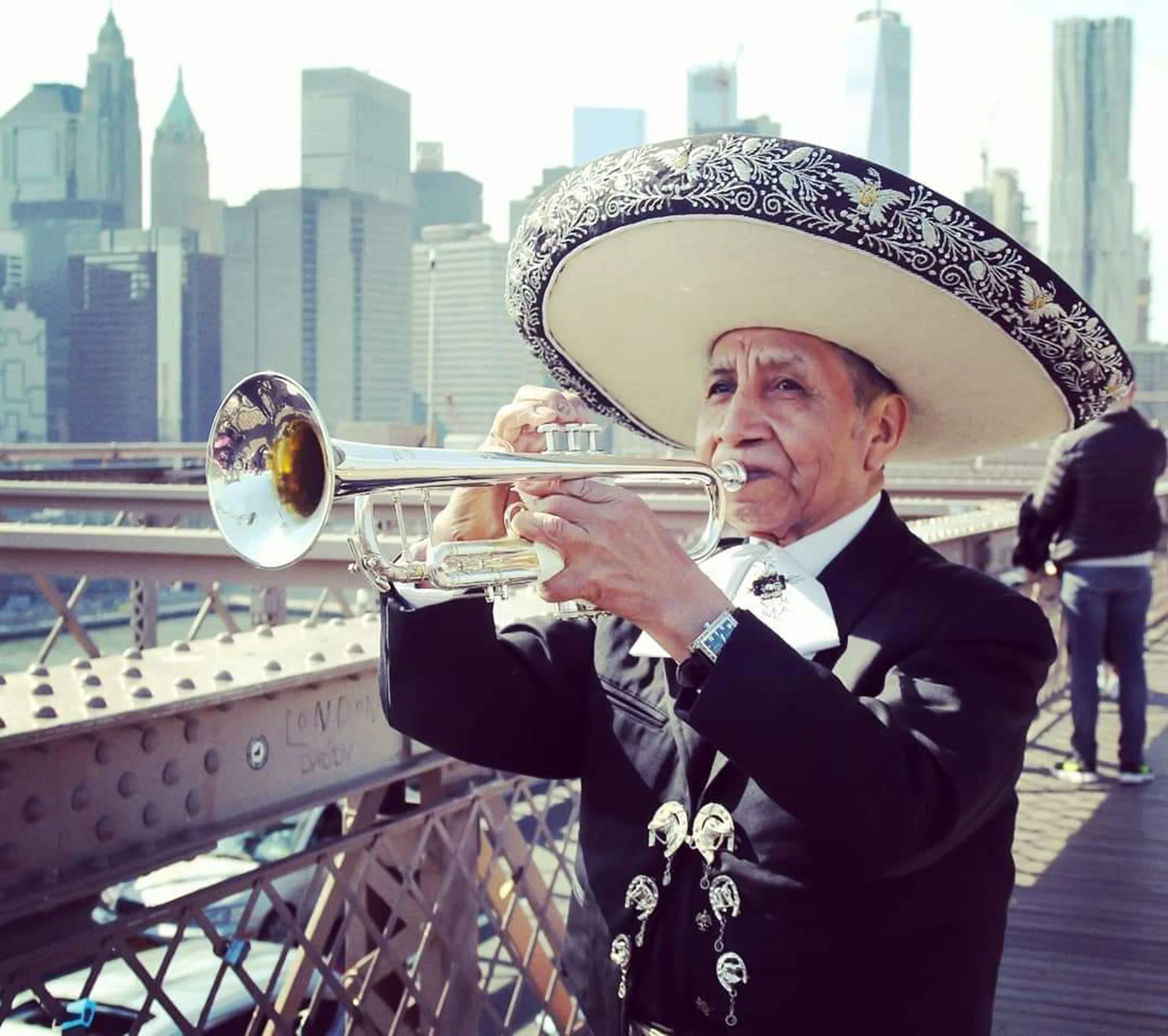
Ramon Ponce Sr., founding member of Mariachi Real de México, on the Brooklyn Bridge. Photo courtesy of Mariachi Real de México
On October 14, Mariachi Real led its biggest show yet at Carnegie Hall, planned by Ramon Jr.. It was the first time that Carnegie had hosted a night of only mariachi music.
The “Mariachi Spectacular” concert featured some of the best in the world: Mariachi Vargas de Tecalitlán, founded in 1897 and referred to by many as “The Best Mariachi in the World”; Mariachi Sol de México, an acclaimed and internationally celebrated group whose founder, Jose Hernández, comes from a family of five generations of mariachi musicians; and the “Queen of Mariachi” herself, Aída Cuevas.
Ramon Jr. dedicated the night’s performance to his father, who was in the audience and played the last show in his 78-year-long career at Carnegie last year.
“At the end of the day,” Ramon Jr. said, “this is all thanks to him.”
When I asked Ramon Sr. how it felt to witness the performance of his family, he simply said: “I wanted to go up there.”
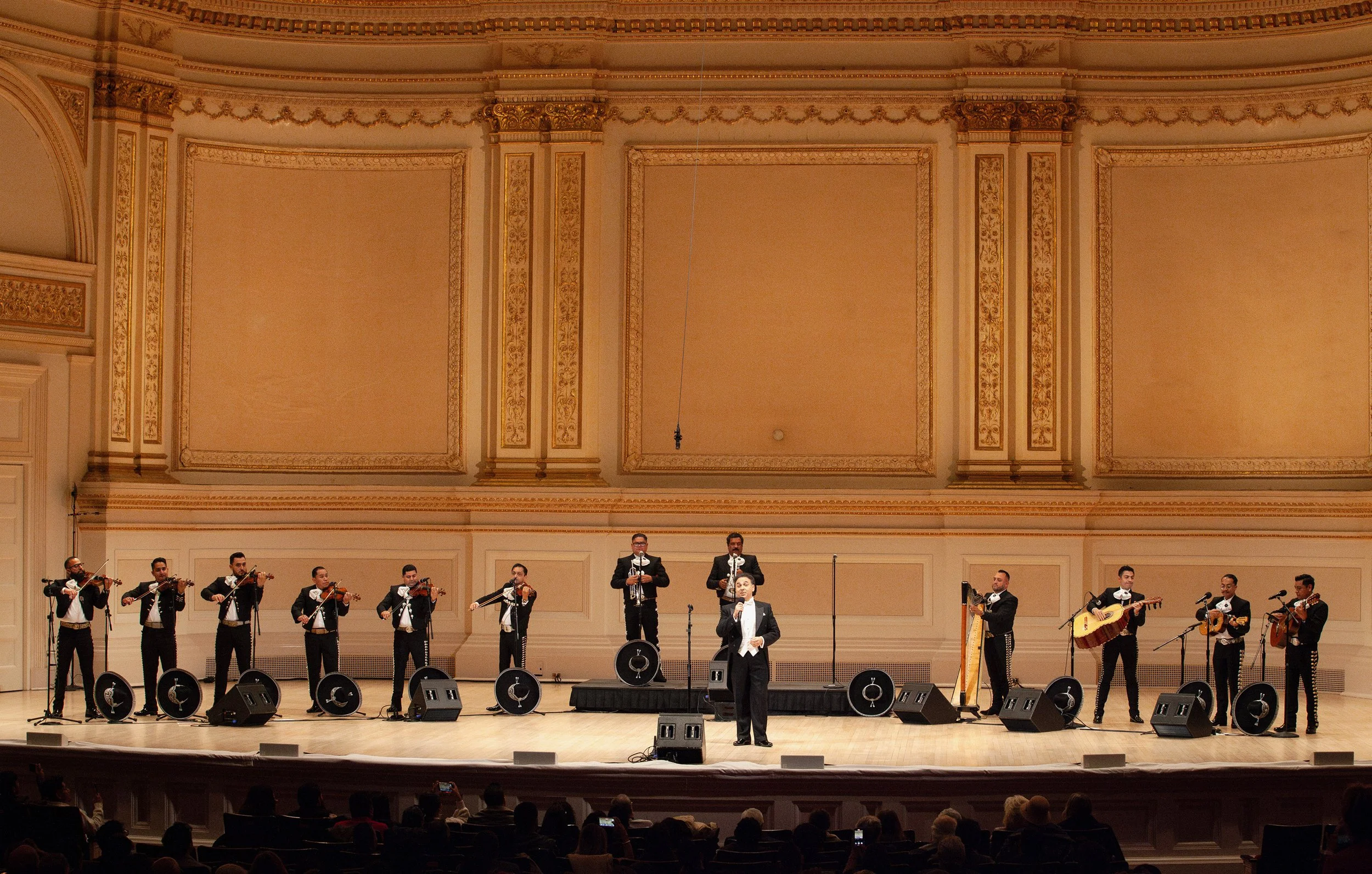
Mariachi Real de México performs with opera singer José Adán Pérez on stage at Carnegie Hall on Oct. 14, 2025. The concert, led by Ramón Ponce Jr., was the first time Carnegie Hall dedicated an entire evening to mariachi music. Photo by Photo by Alesandra Tejeda for palabra
A MARIACHI IN THE HEART OF PUEBLA
Ramon Sr. was born in the town of San Bernardino, Puebla, in 1941, where his father played the tuba in the village band. Ramon grew up hearing him and his older brother play, and he was seven years old when he began playing with them. He picked up the trumpet when he was 20 years old.
At the time, it was routine for the groups he played with to practice for hours in the afternoon and then rest until ten in the evening, when they would go out to perform in town.
“Instead of resting, I would go into the bathroom, close the door, and practice until 9:30,” Ramon said. That’s how he advanced and caught up to his peers who had played longer.
This practice served him well. Soon, he was invited to join Mariachi Puebla. Ramon accepted and soon joined them on their tour around the state of Guerrero. It was the beginning of decades spent touring the country and playing with some of its most illustrious musical talent, including Lola Beltrán and Vicente Fernández, each quintessential icons of mariachi music during its golden age.
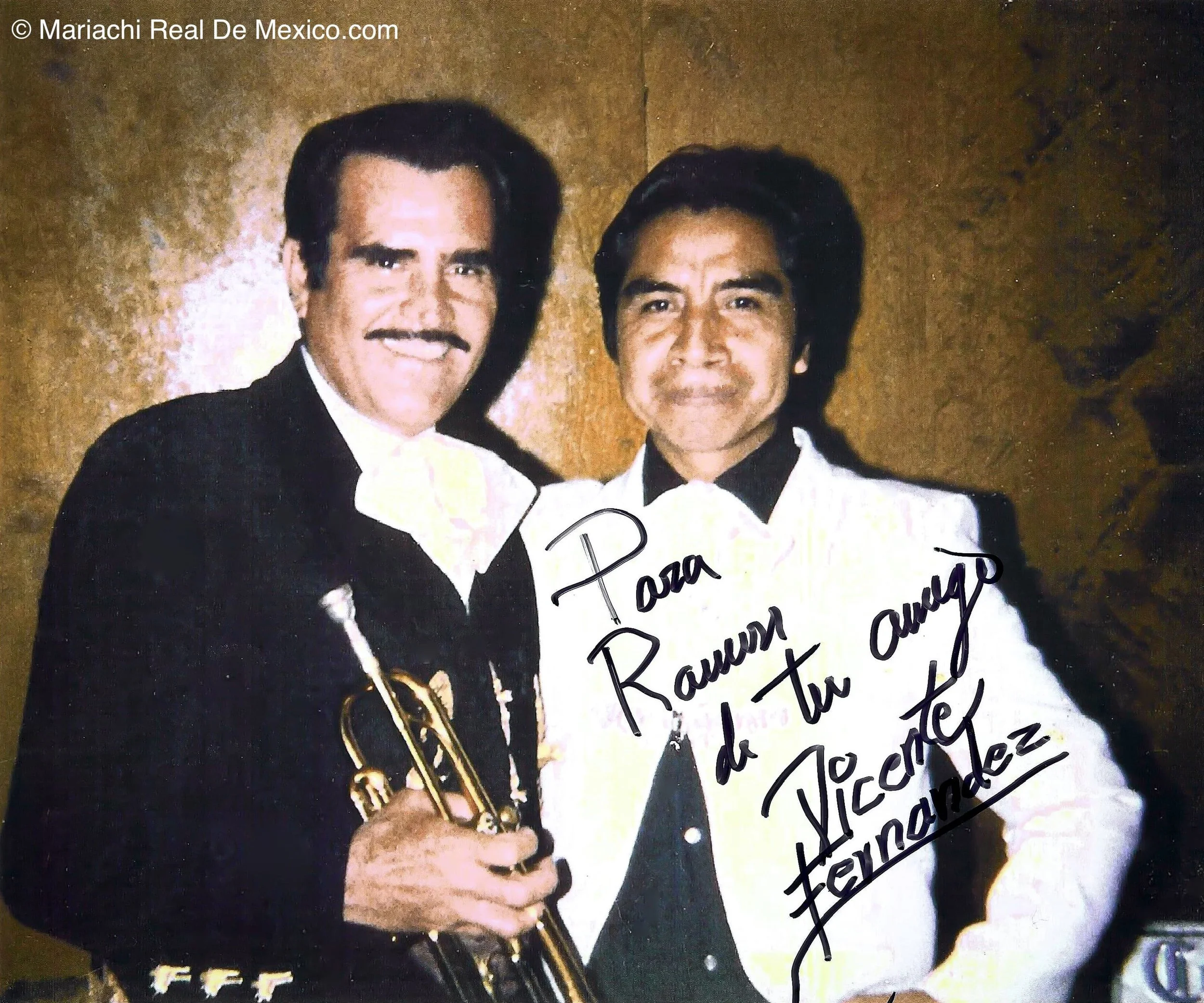
Mariachi legend Vicente Fernández (left) and Ramon Ponce Sr. (right). The photo reads: "For Ramon from your friend Vicente Fernandez." Photo courtesy of Mariachi Real de México
Then came another invitation that would change his life. A group, also called Mariachi Puebla, invited him to play with them in New York. Ramon moved from Mexico on January 12, 1988 — a day he remembers because of all the snow there was when he arrived.
“I didn’t even feel the cold, I was so pleased to be here,” Ramon remembered.
A few months later, Ramon Sr. sent for his son, who was 13 years old at the time.
THE POWER OF ‘LA MALAGUEÑA’
Though the plan was to eventually return to their homeland, Ramon Jr. enrolled in a middle school in Queens.
Soon enough, Ramon Jr.'s teacher, Ms. Kramer, noticed his singing talent and encouraged him to audition for music academies, including LaGuardia Arts.
Support the voices of independent journalists.
|
He didn’t realize back then how famous some of these schools were, or how many hundreds of students auditioned for them. Ramon Jr. said he wasn’t nervous the day of his audition for LaGuardia, which Ms. Kramer personally took him to. In the room, Ramon told the teachers on the audition panel that he didn’t speak English. One teacher responded in Spanish that that was alright, they just wanted to hear his voice.
Ramon sang “La Malagueña,” a Mexican folk song that requires a highly technical and moving falsetto. It was the same song he sang at a contest he won in Mexico when he was five years old.
“It’s my good luck song,” he said.
They accepted him on the spot, a rare occurrence.
Ramon and his father decided to stay in New York. The next year, Ramon Jr. started school at LaGuardia, where he would encounter worlds of music he hadn’t known before, and steadily built a strong foundation of music theory and technique.
At home, Ramon began to take out his father’s old guitarrón, a big-bellied bass guitar, from the closet to play. He loved its sound.
When Ramon Jr. was sixteen, the group Ramon Sr. played in disbanded. It was time to bring a longtime family dream to life. Together, they founded Mariachi Real de México, and Ramon Jr.’s career as a professional musician began.
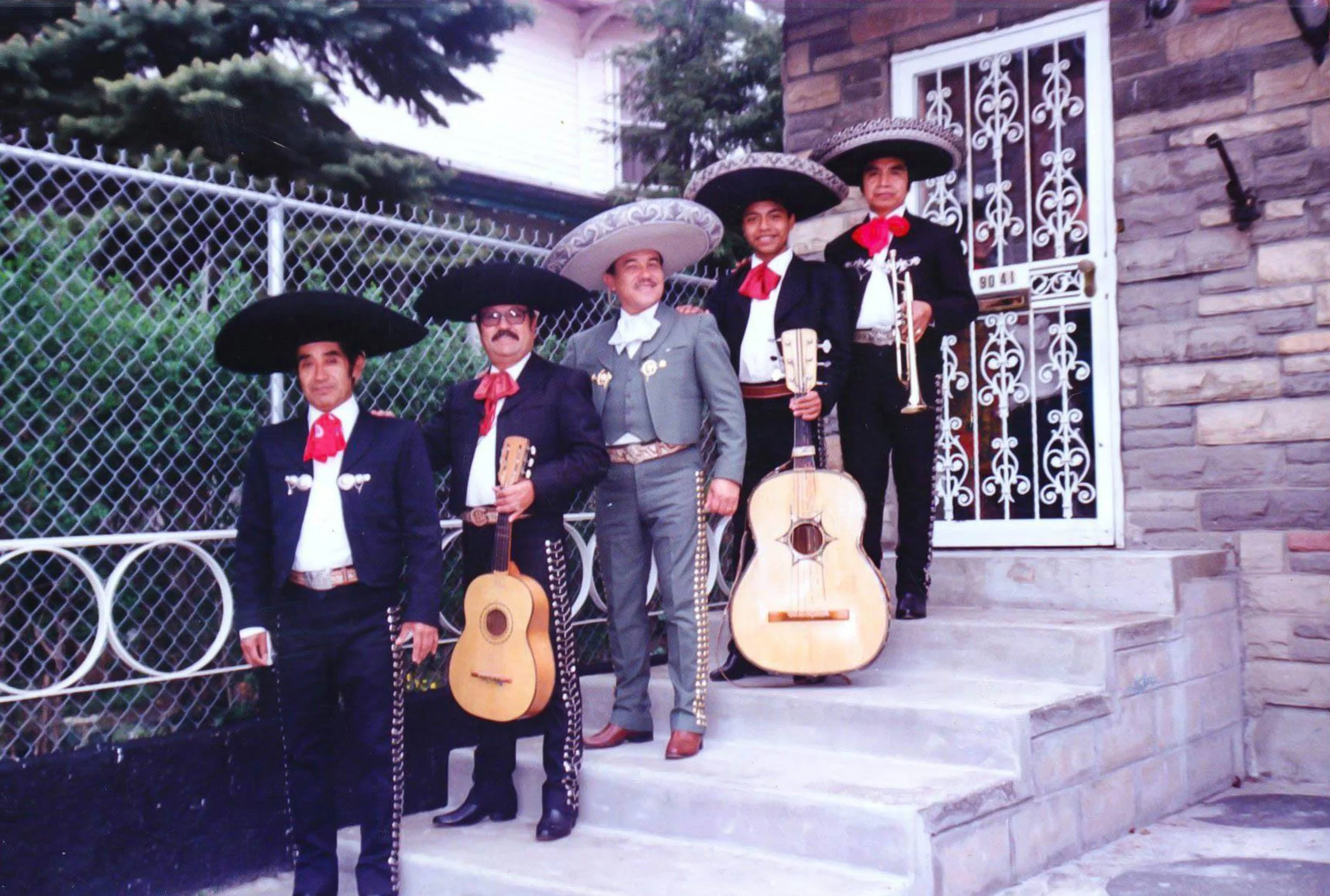
Mariachi Real De México 1991. From left: Pedro Leon (trumpet), Guadalupe Escalera (vihuela), Agustin Garcia (vocalist), Ramon Ponce Jr. (guitarrón) and Ramon Ponce Sr. (trumpet). Photo courtesy of Mariachi Real de México
A NEW YORKER MARIACHI BAND IS BORN
Ramon Sr. invited old colleagues from Mexico to join Mariachi Real. Many of them had decades of experience, while Ramon Jr. had only a few months under his belt.
“They were my university,” Ramon Jr. said. From these musicians, Ramon learned different styles and genres: “Sones, huapangos, rancheras, two-steps, polkas…everything was new for me.”
Like his father once had, Ramon Jr. practiced in his spare time. He kept a small notebook where he’d write down the names of songs the band played that he didn’t know. He would then go get that song’s cassette, listen to it at home, and write his own sheet music for it. He slowly memorized a repertory of varied work that reflected the different experiences and regional roots of the members of the band, as well as the multicultural tastes of a New York public.
In the decades since, the band’s experience and reach has expanded significantly. Though they slowly phased out of the restaurant circuit because of the demand from private events and clients, they continue to play at birthdays and events all over the city, in addition to bigger venues.
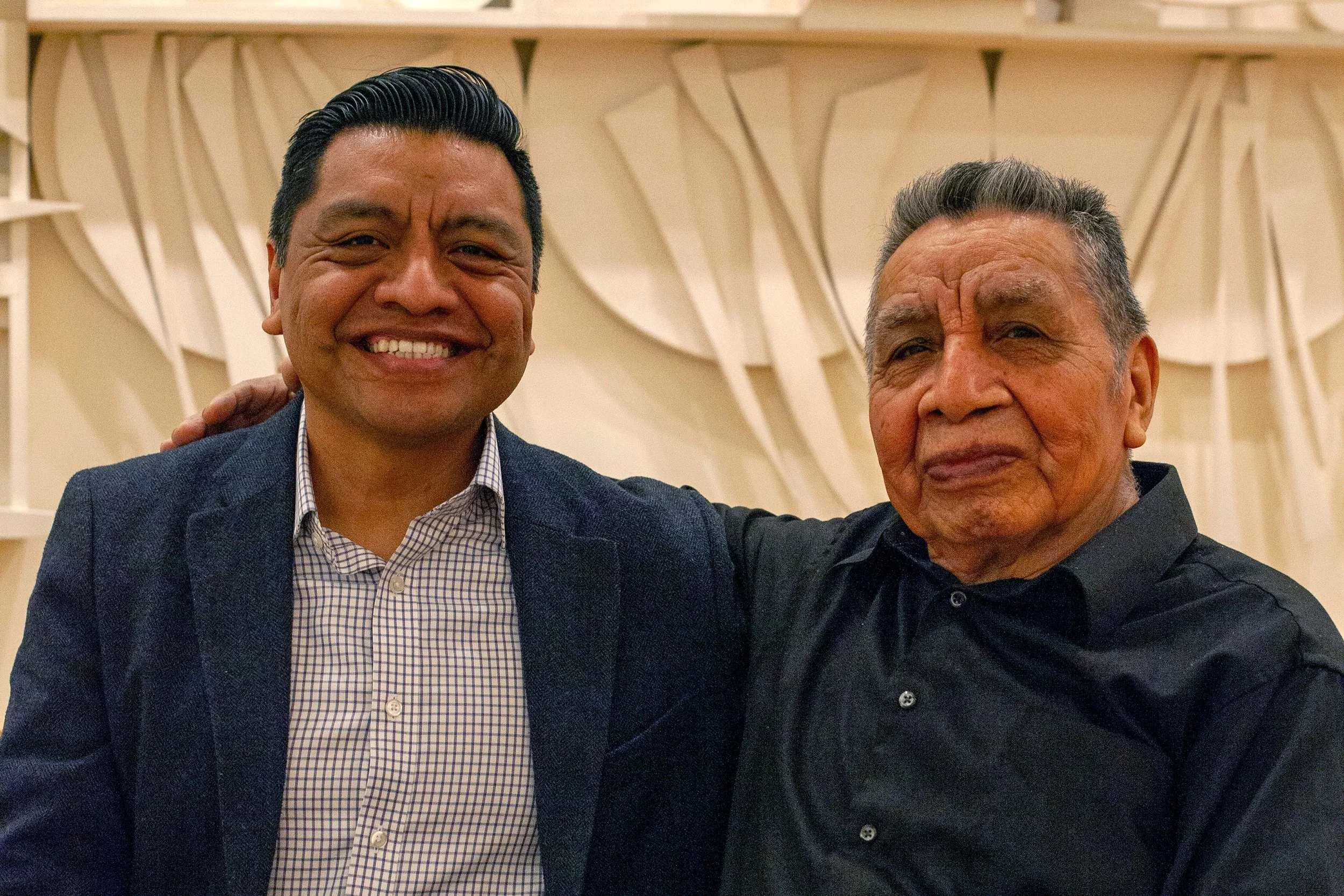
Ramon Ponce Jr. and Sr. at Saint Peter's Church in Manhattan, where they used to teach classes. Photo by Alesandra Tejeda for palabra
A MARIACHI ACADEMY FOR ALL
In 2002, Ramon Jr. and Sr. founded a music academy, the first on the East Coast and the only free one in the country for young people to learn to play mariachi music. Out of the hundreds of students they’ve trained, many have gone on to pursue their own careers.
Though, the school is not some kind of mariachi “factory,” Ramon Jr. said.
“Since day one, our goal has been to share mariachi music and to educate not only young people but the general public about what traditional mariachi music really is.”
As Ramon Sr. put it: “It gives me pleasure that these kids and my grandchildren are continuing the musical family tradition.”
The advice that he gives them? “Échale sentimiento!” Put some feeling into it.
Ramon Jr. often gets the young mariachi students involved in the prestigious events they play at.
Just before the Mariachi Spectacular show started at Carnegie, kids from Mariachi Academy and another mariachi school in the city stood at the back of the auditorium, waiting for the moment when they would walk down the aisles and join in with the first song.
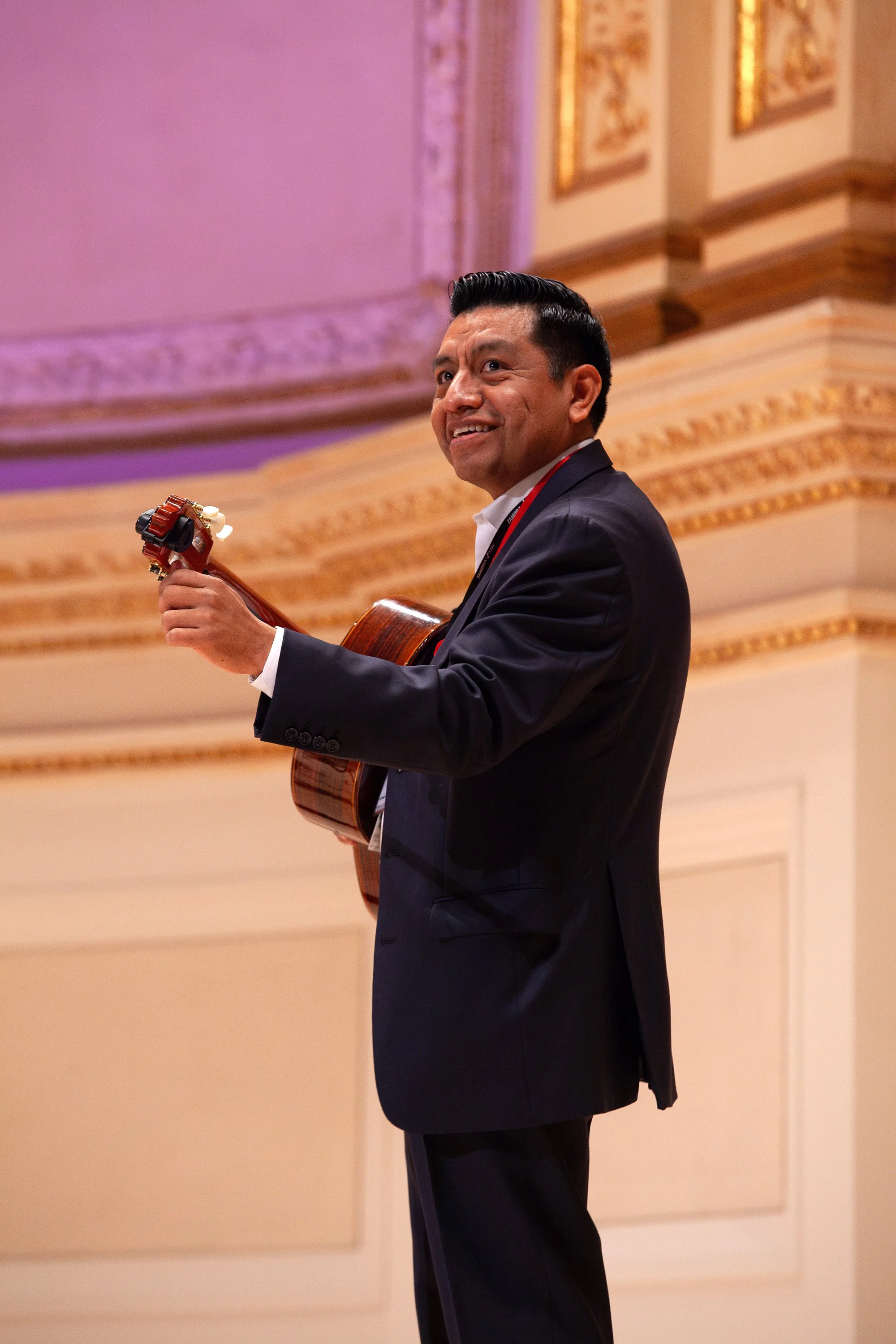
Ramon Ponce Jr., during a rehearsal for the Mariachi Spectacular concert on the Carnegie Hall stage. Photo by Alesandra Tejeda for palabra
A ‘SPECTACULAR’ DREAM
Ramon Jr. had been organizing the Spectacular for over a year, though he had the idea many years before. He hopes it will be the first of many that can raise money for student scholarships at the various mariachi academies in the city.
As the inaugural event got closer, he said he felt his dream develop “like a Polaroid.”
“Each day it became more clear,” Ramon said.
His day-to-day life running the band is usually full of logistics. But on stage, he feels like a kid. “You stop worrying, and you just enjoy it.”
Nayeli Chavez-Geller, a reporter and presenter for Univision, introduced the show, at one point tripping over her words.
“I was moved,” Chavez-Geller later said.
“It struck me as a very dignified and historic moment,” Chavez-Geller said.
Then the trumpets, violins, and guitars erupted into the first song: “Son De La Negra.” The audience roared. The venue’s ban on cellphone use became immediately impossible to enforce. Other usually “disruptive” displays of joy that were tolerated throughout the night: audience members standing for a better view, dancing, waving flags, shouting (“¡Viva México!” in the middle of a song) and chanting (“¡Otra!” at the end of a set).
On stage, history was being made.
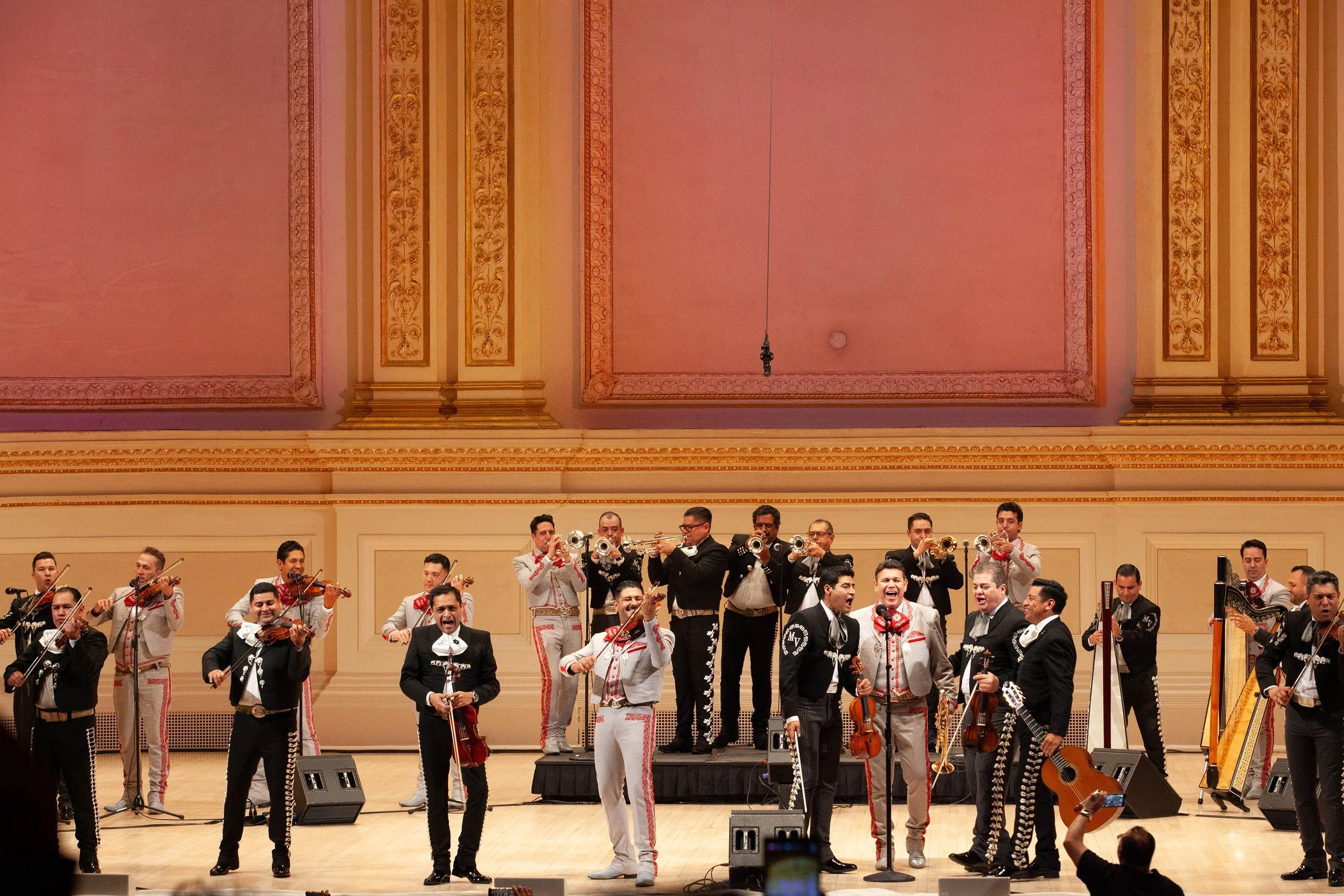
Members of the three bands playing at Mariachi Spectacular: Mariachi Real, Mariachi Sol, and Mariachi Vargas, performing together for the last song of the night at Carnegie Hall. Photo by Alesandra Tejeda for palabra
One audience member, Yolanda Maya, said that she and her friend, Lorena Sanchez, came to enjoy Mexican music and culture, particularly in the current political moment, in which many in the Latino community feel fearful and intimidated.
“We were all created equal,” Maya said. That’s the message that music has power to impart.
“The political climate didn’t stop us,” Sanchez added. “We were determined to enjoy our culture and be part of this marvelous event.”
During the intermission, Gabriel Fonseca Flores, an attendee from Puebla, asked me whether I could do him a favor. He wanted to propose to his girlfriend at the end of the show and needed someone to record it.
When I later asked him why he chose that night, he said that he and his Dominican girlfriend both love mariachi music. He even sang “Hermoso Cariño,” a romantic serenade by Vicente Fernández, at her mother’s birthday. He decided the show was the perfect place to propose.
Aída Cuevas came out for the grand finale. At the end of her last song, she thanked God for the gift of singing ranchera music and getting to wear its emblematic charro suit.
“Because this is the outfit that represents us anywhere in the world,” Cuevas said to a cheering crowd.
At the end of the show, as the audience members headed home, Flores delayed his girlfriend from leaving their row. Then he turned around and got down on one knee. The people around them noticed and cheered.
She said yes.
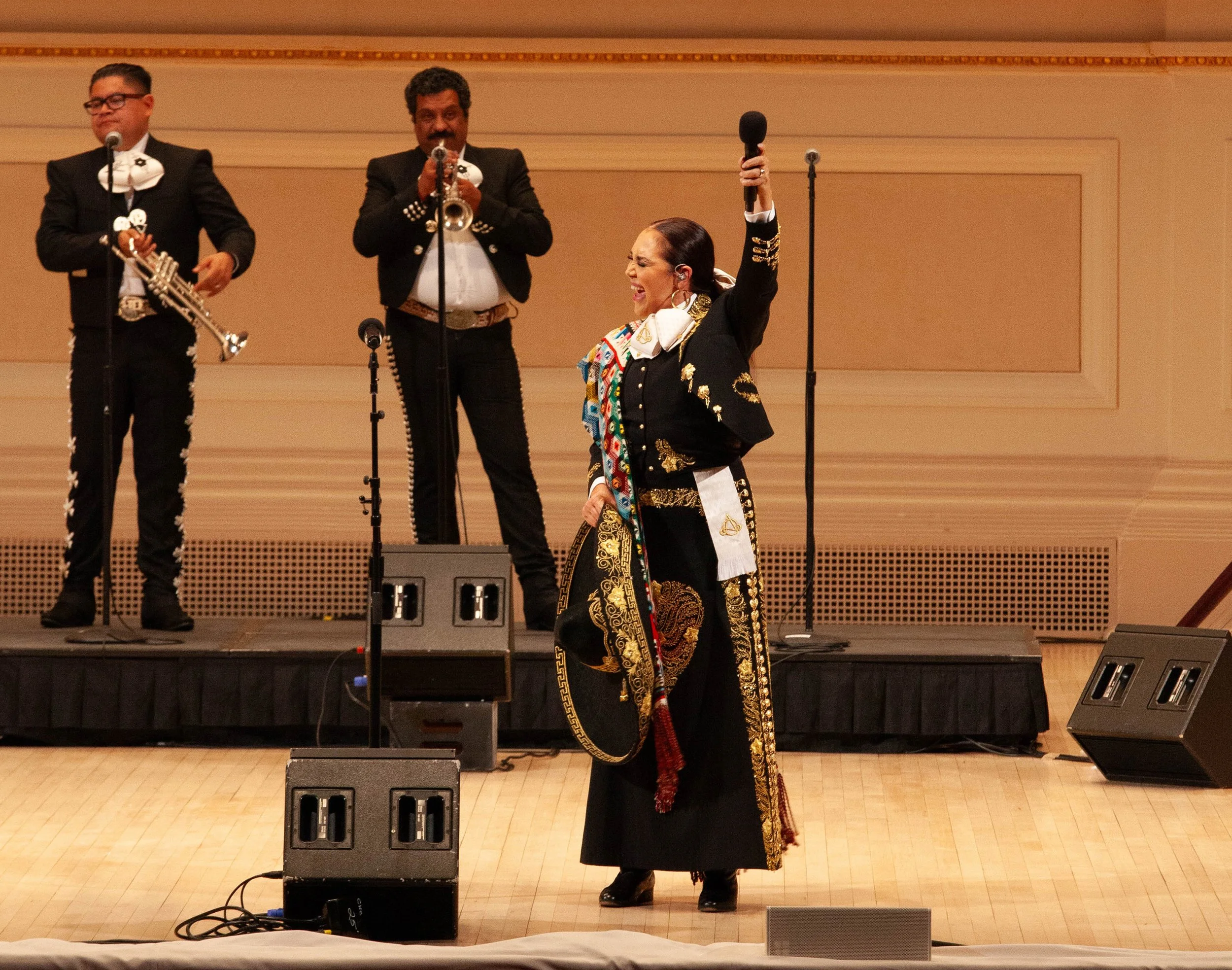
Aída Cuevas performs with Mariachi Real de México and invites the audience to join in on her song at Carnegie Hall. Photo by Alesandra Tejeda for palabra
—

Alesandra Tejeda is an award-winning multilingual writer, photographer, and audio producer based in New York City. She has contributed to the Colorado Independent, the Brooklyn Paper, the Washington Post, The Creative Independent, and Written in Air magazine. She studied environmental studies and journalism at Colorado College before moving to New York to produce podcasts with Wonder Media Network, where she helped produce bilingual stories and contributed to award-winning shows like “As She Rises.” She traveled the world as a Watson Fellow and is now a Literary Reportage fellow at NYU. She was born and raised in Mexico City. @tejedale | alesandratejeda.com

Rodrigo Cervantes is an award-winning bilingual journalist and communications strategist with extensive experience in the U.S., Mexico, and internationally. He has contributed to outlets such as NPR, CNN, The Los Angeles Times, and the BBC. Cervantes led KJZZ’s Mexico City bureau, where he launched the first overseas bureau for a U.S. public radio station. He also served as Business Editor-in-Chief for El Norte, part of Grupo Reforma, Mexico’s leading newspaper company. In Georgia, he led the newsroom of MundoHispánico, then the state’s oldest and largest Latino publication, under The Atlanta Journal-Constitution. His work has been recognized with RTDNA Murrow Awards and José Martí Awards from the National Association of Hispanic Publications (NAHP). He is the former Secretary of the National Association of Hispanic Journalists (NAHJ) and currently serves as co-managing editor of palabra, and as a clinical assistant professor at Arizona State University’s W. Cronkite School of Journalism and Mass Communication. @RODCERVANTES