
OPINION | Miss Universe: a Masterclass on Perpetuating Machismo in Puerto Rico

International Women’s Day protest in San Juan, Puerto Rico on March 8, 2024. Photo: Carlos Berríos Polanco
Looking at our cultura via a critical lens means asking (and answering) the difficult questions, honestly.
Clic aquí para leer en español.
Text by Lola Rosario
Edited by Douglas Gómez Barrueta
LOÍZA, Puerto Rico.- In Puerto Rico, toxic masculinity is embedded in the fiber of our culture. From music to family dynamics, interpersonal relationships to public and political discourse, the violence of machismo is everywhere. It is an ideology that (re)enforces traditional gender roles, treating women as entertainment and possessions rather than autonomous individuals. And with the upcoming 75th Diamond Edition of Miss Universe, to be held here in San Juan, once again femmes will parade for the patriarchal establishment — disguised as empowerment.
But while millions across the globe gather for the glitz and glamour, I wonder if they’ve ever considered what lurks on the other side of the spectacle. I’m curious what they make of the violence against our bodies, and the normalization thereof.
Our Bodies, Whose Rights?
Since 1937, Law 136, which made abortion legal, allowed for the “interruption of a pregnancy” only as necessary to save the mother’s life or to protect her health. For decades, the legality of the procedure was more of a nearly non-existent social practice.
In a 1998 research paper, Rosa E. Marchand Arias, Ph.D., Retired Professor at the Graduate School of Public Health, University of Puerto Rico examined the contradictions between the legality of abortion and its secretive social practice from 1937 to 1970, highlighting doctors’ refusal to perform legally authorized abortions for women's health, citing illegality.
Then we saw the 1980 case, Pueblo de Puerto Rico v. Pablo Duarte Mendoza, in which the Supreme Court of Puerto Rico overturned the 1973 conviction of a doctor who performed an illegal abortion on a 16-year-young girl, stating that U.S. constitutional jurisprudence on abortion applies in Puerto Rico. The court ruled that during the first trimester, the decision to perform an abortion is based on the physician's clinical judgment regarding the patient's health.
Fast forward to 2026.
Puerto Rico's Governor Jenniffer González Colón signed Senate Bill 923 into Law 18-2026, amending the Penal Code to define the unborn - at any stage of gestation - as a human being. While supporters view it as progress aligning with the 2025 Keishla Madlane Law (on crimes against pregnant women), critics, such as Planned Parenthood, argue it criminalizes reproductive rights, adding that because the bill “does not include any explicit exceptions for abortion providers or patients, it leaves an ambiguous legal climate.”
subscribe to Palabra’s newsletter
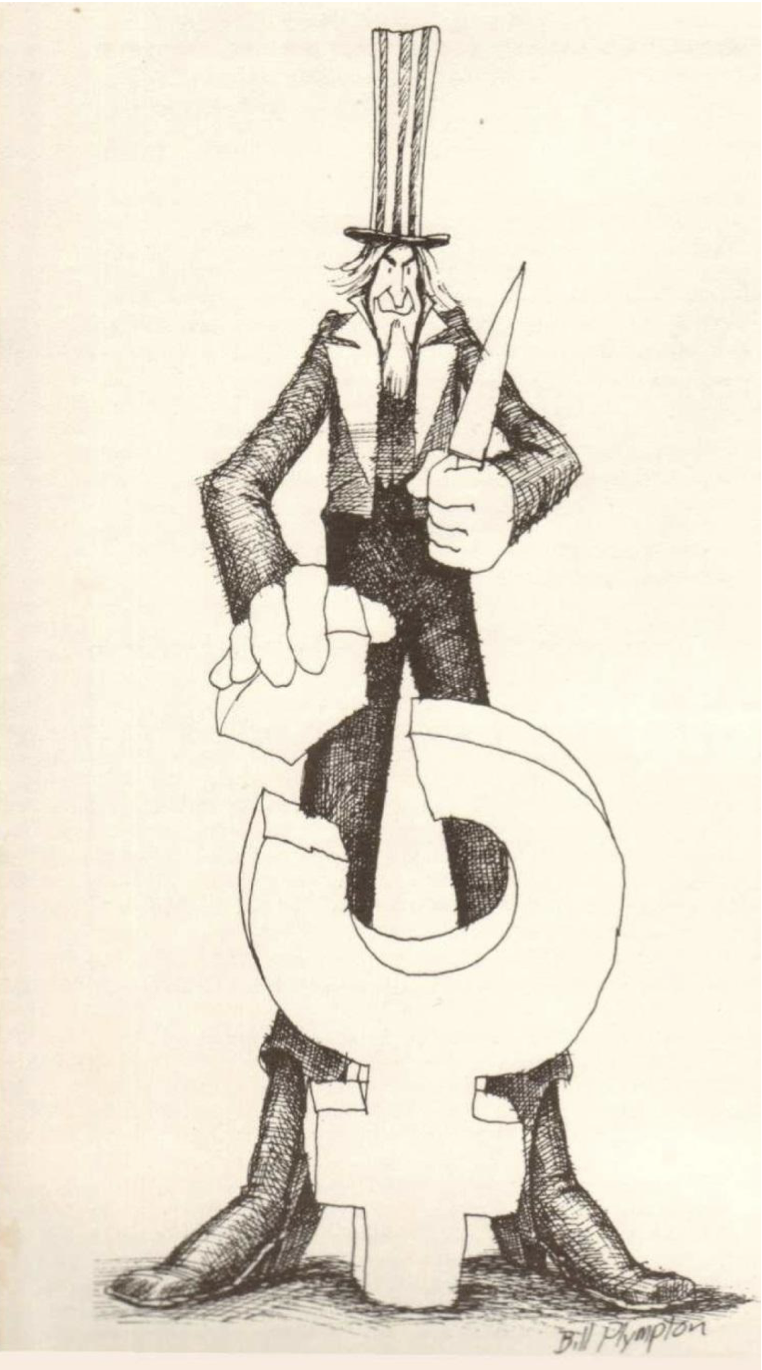
Forced Sterilization “Cartoon” Uncle Sam with a knife cutting the feminine Venus symbol, November 2016. Artist: Bill Plympton / source: FreedomArchives.org
This is yet another attempt by the patriarchy to exercise control over our bodies and sits disturbingly against the backdrop of the history of forced sterilization in Puerto Rico. Referred to locally as La Operación, it has been documented that between the 1930s and the 1970s, approximately 35% of the child-bearing population here was sterilized - without the benefit of full disclosures and alternative options for birth control. Few are surprised to know that our Caribbean archipelago jewel has one of the highest sterilization rates in the world.
A Culture Meriting Machismo
Support the voices of independent journalists.
|
Machismo is the phallus of the patriarchy. In Puerto Rican culture, as in most of Latin America, it promotes traditional gender roles, masking its toxicity behind men as providers and protectors. It’s where real men don’t cry and their aggressive behavior is deemed an attribute. It’s why their social mobility is rarely questioned, while women face heavy scrutiny (e.g., our clothing, sexual morality/dating habits, physical appearance).
Given this context, machismo is the perfect paradoxical platform for the shenanigans of Miss Universe 2026. On one end, Puerto Rico [and the world] elatedly watches a celebration of “empowered” womanhood. On the other, a shadow of machismo and systemic violence continues to claim the lives of women across the archipelago. Such a cultural disconnect reveals a society completely out of touch with the ongoing femicide crisis here.
Fortunately, one segment of our population has remained fiercely committed to removing those blinders.
Feminist organizers and activist leaders, like Coordinadora Paz para las Mujeres (CPM), a nonprofit coalition with 30 years of experience advocating for survivors of domestic violence and sexual assault,
pressured the government into action. In January 2021, then governor Pedro Pierluisi declared a State of Emergency. Vilma González-Castro, CPM’s executive director told palabra it was a step in the right direction because it set a precedent to hold government officials accountable and it accelerated the allocation of resources to combat gender-based violence, domestic violence and sexual assault. (GBV, DV & SA).
But, more must be done.
“On one end, Puerto Rico [and the world] elatedly watches a celebration of “empowered” womanhood. On the other, a shadow of machismo and systemic violence continues to claim the lives of women across the archipelago.”
—Lola Rosario, journalist

Where is the State of Emergency? International Women’s Day protest in San Juan, Puerto Rico, on March 8, 2024. Photo: Carlos Berríos Polanco
It has been nearly six years since the Estado de Emergencia was declared. This past March, The Centre for Puerto Rican Studies shared an alarming statistic on their Facebook page. According to Observatorio de Equidad de Género (OEG), “every seven days, a woman in Puerto Rico falls victim to femicide.” OEG is an independent, feminist and human-rights non-profit project that monitors gender-based violence, collects, analyzes and verifies data statistics therefrom to impact public policy change. Their latest report, October 14, 2026, reflected 52 femicides (of which 43 are what they refer to as direct femicides).
The Observatorio shared that this past May was the most lethal month with 10 femicides. Instead of improving the awareness, the Puerto Rican government is spending nearly $9 million on Miss Universe. Rather than focus on the dire needs of the people -this past June, I spent 5 days walking nearly 2 miles to fill up water bottles - our politicians are caught up in the pageantry. Apparently, their priority is topping last year’s record where Telemundo’s live broadcast reached 2.6 billion views globally across social media platforms.
Right. Because this is exactly the type of “education” our children are lacking.
Education is Key
A fundamental change is needed if there’s any hope to curb gender-based violence in Borinquen Bella.
Some proponents say it can only start in the home. And while I don’t disagree that’s the best starting point, I know for some families, it might not happen as quickly - not because they don’t want to, but rather because their plates are overflowing with other priorities. Valeria R. Salomé, a social worker specializing in gender-based violence, shared her experience with palabra, saying “families struggle daily to meet basic needs, like food, water, light, access to basic welfare matters.” She added that “If these needs aren’t being met, then the rest become secondary.”
Here’s where education is crucial, especially for young children.
Because Puerto Rico's Department of Education has faced ongoing delays, political pushback, and shifting official directives on a mandatory, structured gender-perspective curriculum in public schools, grassroots organizations like Loíza-based Taller Salud have implemented community workshops geared toward younger persons. Founded in 1979, the feminist, anti-racist non-profit’s mission is to nurture women’s leadership to co-create well-being, comprehensive health and community development. Through Project AMANI, preteens aged 10-13, learn to use music and group dynamics to develop emotional intelligence and promote early gender equity.
Initiatives like these foster self-awareness and self-respect. Someone who learns these in childhood stands a much better chance at creating healthy interpersonal relationships and setting boundaries, leading to a kinder cultura.
—
Lola Rosario is a Puerto Rican freelance journalist and poet based in Loíza.