
Murals And Money
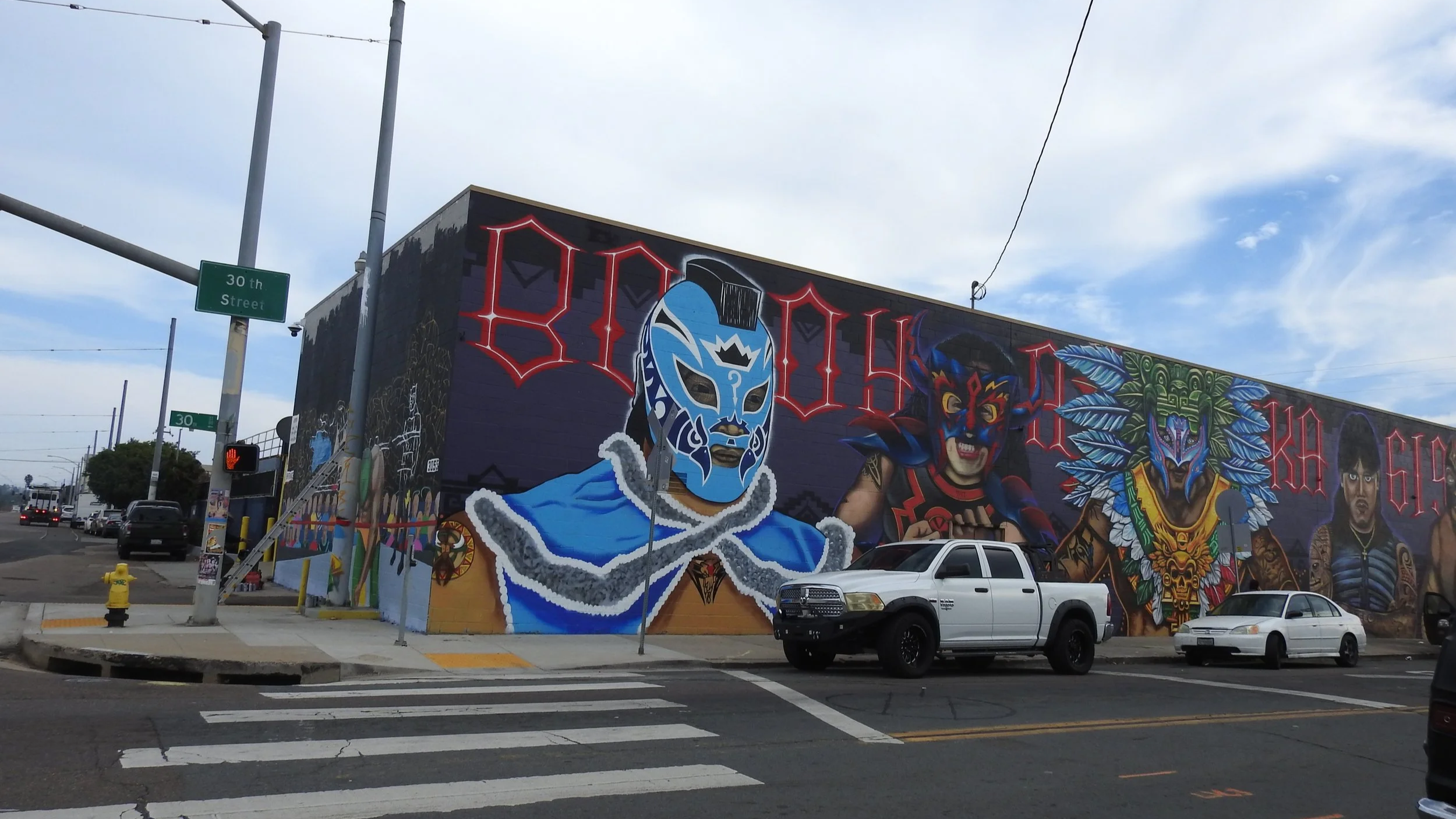
Dentlok's mural while it was still a work in progress.
Residents in San Diego’s historically Latino Barrio Logan sound the alarm over gentrification and a threat to the neighborhood’s landmark murals

Editor’s note: This story was co-published with Puente News Collaborative in partnership with KTEP News. Puente News Collaborative is a bilingual nonprofit newsroom, convener, and funder dedicated to high-quality, fact-based news and information from the U.S.-Mexico border.
Words by Roberto Camacho, @rob_camacho_sd
Edited by Patricia Guadalupe, @PatriciagDC
Photos by Jesse “T.C.” Cannon, @cano_photography_pt2
SAN DIEGO, Calif. – On a typically cool spring morning in San Diego, muralist Daniel Angeles took a phone call that chilled his soul: His first piece of public art in the city’s Latino-centric Barrio Logan, a large mural called “Birth of the Hummingbird,” was being erased. He clicked on a live video and was horrified that his masterwork was being painted over – the vibrant colors of his mural gradually covered by mundane, muddy browns.
Angeles called the property’s owner, who, years before, had allowed him to paint the building’s street-facing wall and fence. Angeles thought of invoking the California Art Preservation Act and the federal Visual Artist Rights Act of 1990, written to help artists preserve public works. Damaging or modifying works without an artist’s consent can be unlawful. Property owners are supposed to send notice three months before demolition or repainting, giving artists time to remove, document, or relocate their murals.
“I was shocked. I couldn’t do anything since I was at a music performance for my oldest daughter,” Angeles said. “She was performing when this youngster FaceTimed me as he was running towards the wall to show me a couple of guys were going over the art with rollers and dark paint. I couldn’t believe that it was going away.”
Angeles, who paints under the name Dentlok, is a celebrated muralist, tattoo artist, and long-time resident of the neighborhood. He said he received no warning before his prized mural was erased.
But with the erasure of his prized mural, Angeles became a focal point in a simmering conflict in a neighborhood that Latinos have spent generations transforming from an overlooked, low-income enclave into a vibrant hub for art, food, and culture. The Barrio Logan fight over gentrification and public art became another in a series of similar, complicated struggles in communities around the country.
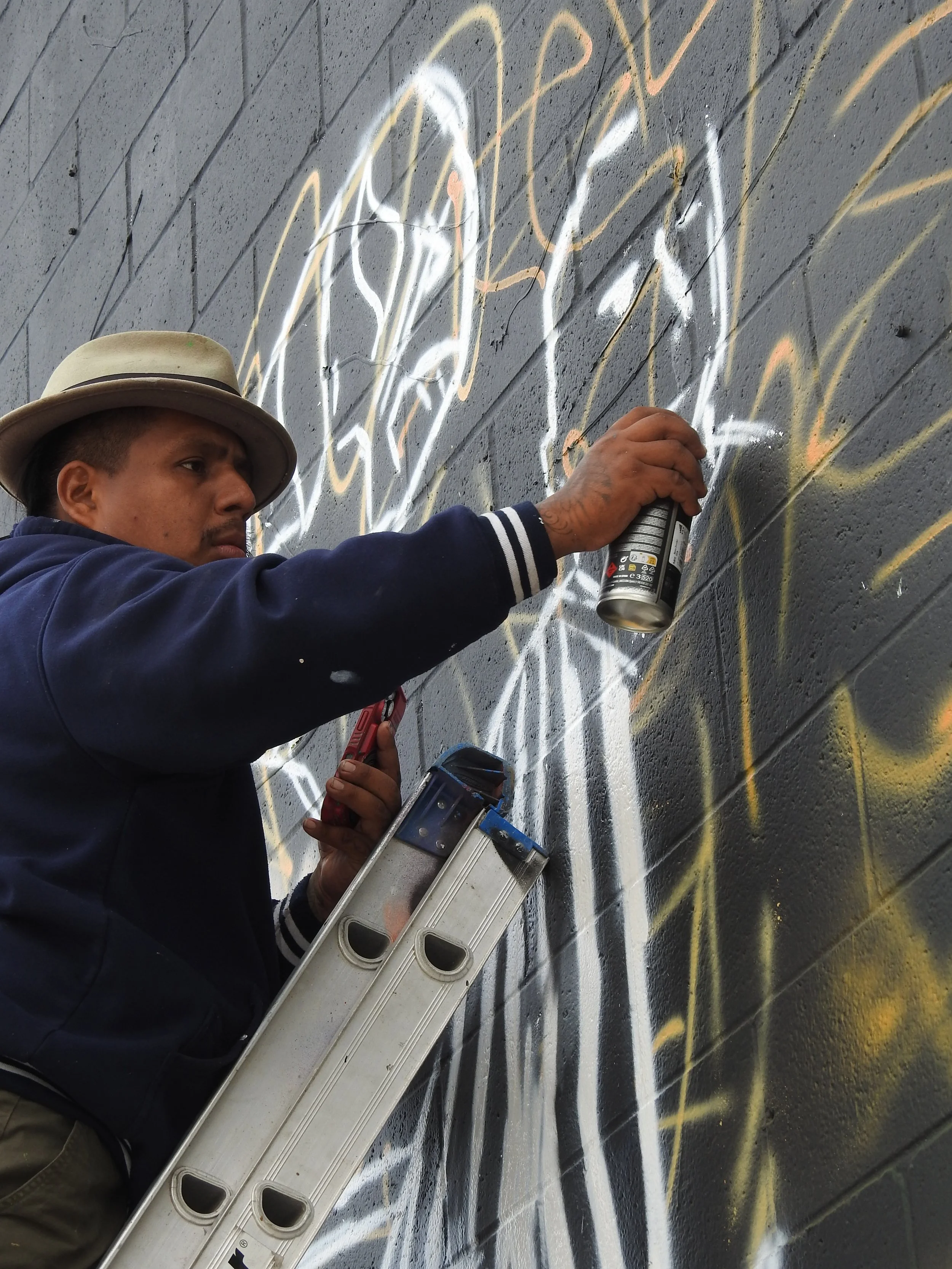
Dentlok in the zone. His style of mural work is highly detailed and meticulous.
The Chicano Art Movement
Barrio Logan became the center of San Diego’s large and politically active Chicano (Mexican American) community following the Chicano Rights and student movements of the 1960s, along with the construction of massive freeway overpasses and the Coronado Bridge, which reshaped downtown San Diego and recast its bay from a military-industrial pool to a bustling public recreational and cultural space.
But the transportation projects installed massive, concrete freeway pillars that cleaved Barrio Logan and its sister neighborhood, Logan Heights, from the rest of urban San Diego. They were considered eyesores until local artists rallied to cover them with images that narrated the neighborhood’s “Chicano Power”: farmworkers, students, lowriders, and social activists juxtaposed against Mexican indigenous icons and mythology. What was first considered insurgent graffiti blossomed into the landmark Chicano Park, now a National Historic Landmark that draws visitors from around the world like an outdoor museum. The art wave spread across Barrio Logan, and the neighborhood was named a California Cultural District, popular for its outdoor murals and a concentration of galleries and small businesses.
Today, San Diego is among the nation’s most expensive cities. It takes an annual income of some $250,000 to afford a median-priced home. As a result, Barrio Logan has become a destination. Its low land costs and proximity to downtown San Diego are attracting new residents and real estate development. But that’s also now threatening the very art that put the neighborhood on the nation’s cultural map.
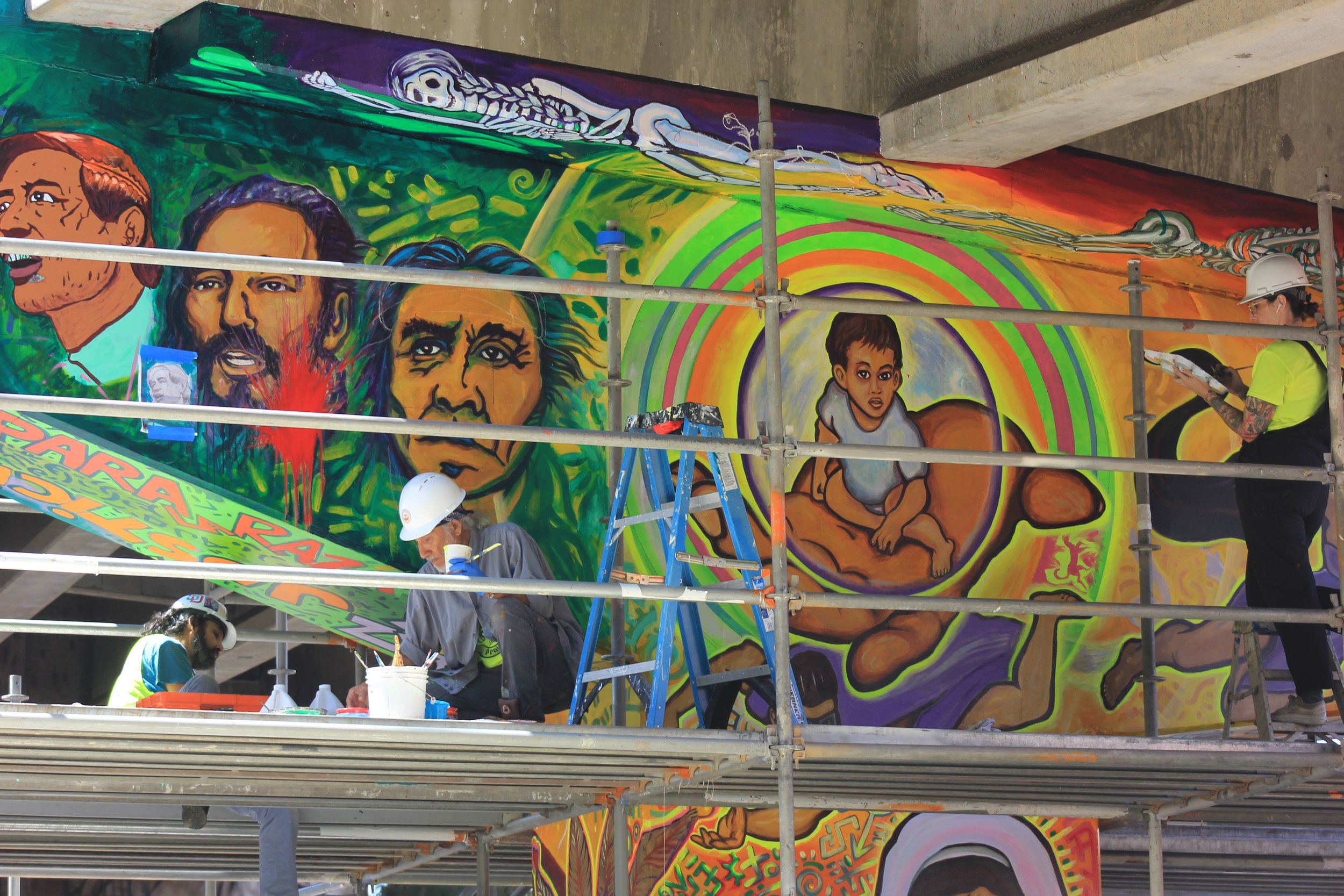
Mario Torero and crew hard at work on the backside of the La Tierra Mia - Jose Gomez mural. Chicano Park Mural Restoration Project 2023
Priced out by success
Displacement of long-time residents of working-class neighborhoods – many of them communities of color – in cities across the U.S. is a hot-button issue from New York City to Los Angeles. Property owners and commercial interests will always be drawn to communities with newfound appeal, especially reborn neighborhoods once overlooked as crime-ridden or lacking economic opportunity. That creates tension between economic opportunity and renters, and social activists who fear affordability gaps and fading cultural identities – factors that once made marginalized people feel they belonged, having constructed their own versions of the American Dream.
“Gentrification that is currently happening in Logan Heights or in the Mission District is not new, but it would also be a mistake to assume that it is normal, or for that matter, a ‘natural' process,” said Roberto D. Hernández, professor of Chicana and Chicano Studies at San Diego State University. “Gentrification that is currently happening in Logan Heights or in (San Francisco’s) Mission District is not … a ‘natural' process.”
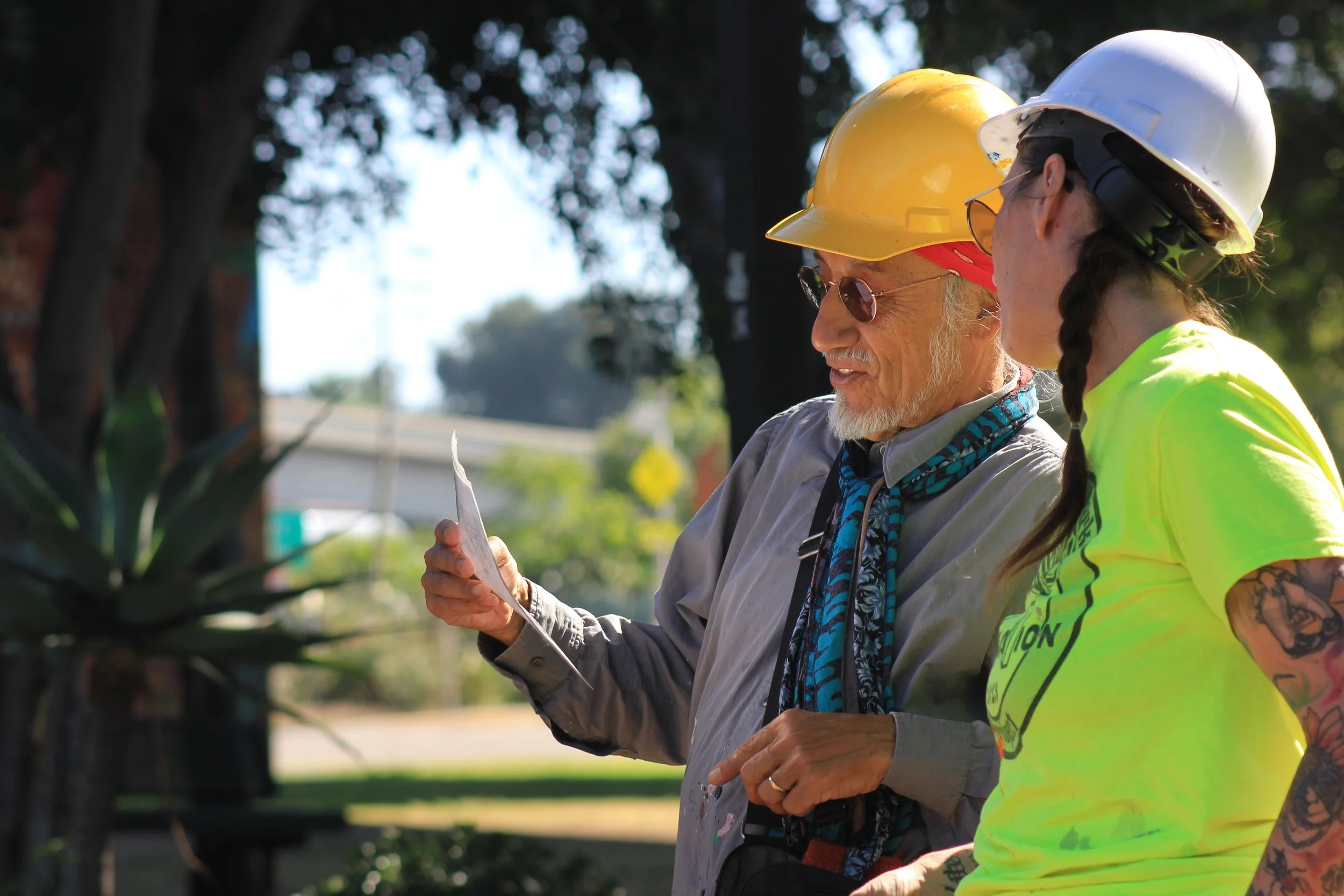
Mario Torero and Shirish Villaseñor looking over their plans for the day. Chicano Park Mural Restoration Project 2023
It is essential to invest in impoverished/historically neglected communities, Hernández added, but too often investors’ interests are not in sync with those of a neighborhood’s original residents. New investments that raise property values are good for owners, but they price out long-time residents. “The million-dollar question is: How to (develop) in a way that actual community members can stand to benefit from the improved communities,” Hernández said.
In Barrio Logan, state and federal art and cultural designations sought a balance: legal protections for artists and recognition for the work of longtime residents and civic activists. But also economic development and the community profiting from its art and cultural identity.
Support the voices of independent journalists.
|
But that attempt at balance left some loopholes: Murals outside of Chicano Park – and public art on private property in Barrio Logan – are not fully protected against removal if they are damaged or, more commonly, when new owners acquire property.
“In communities like Barrio Logan and southeast San Diego, murals play an important role in maintaining the identity of the neighborhood,” Angeles said. “They document the history and culture our ancestors left for us. It’s our roots in this city, and it represents us, the community,” that redlining and racism once tried to isolate us.
Weeks before Angeles’ mural was destroyed, Mario Torero, one of the founding Chicano Park muralists, discovered that one of his works, the mural “La Vida es un Sueño” (Life is a Dream), was painted over without his knowledge. Torero created the mural in 2010 as part of a “No Borders Show” – a collaboration with artists from across the border in Mexicali, Mexico. Over the years, the mural had fallen into disrepair, suffering damage from sun exposure and even intrusive graffiti taggers.
Torero says he wasn't entirely surprised that the mural was removed. He was, however, surprised that he learned of the mural’s whitewash demise in a text-messaged photo from a friend.
Torero mentions that he was contacted by representatives of the building’s owner in 2023 to discuss renovating the wall to protect the mural. But the talks stalled. Torero said the company that manages the property claimed that the city of San Diego had warned the building’s owner of fines if the graffiti-laden wall and mural were not painted over or removed. (A public records search yielded no reports or code violations related to the building.)
Sarah Mondragon, founder of Barrio Artists Partnership, a local nonprofit advocacy group that represents street artists, said Torero and the BAP had proposed a collaborative restoration. Mondragon says that although the property owners appeared receptive to the new design, they never followed up. Mondragon and Torero said they even offered to pay for the mural’s relocation and restoration. To date, they’ve not heard back from the property owners.
Mondragon added that the erasure of public art in Barrio Logan parallels rising rents and the displacement of families, small businesses, and cultural nonprofits. “By removing murals, developers not only alter physical walls but erase the social identity of the community itself. For us, mural preservation is cultural preservation — an act of resistance against displacement and invisibility.”
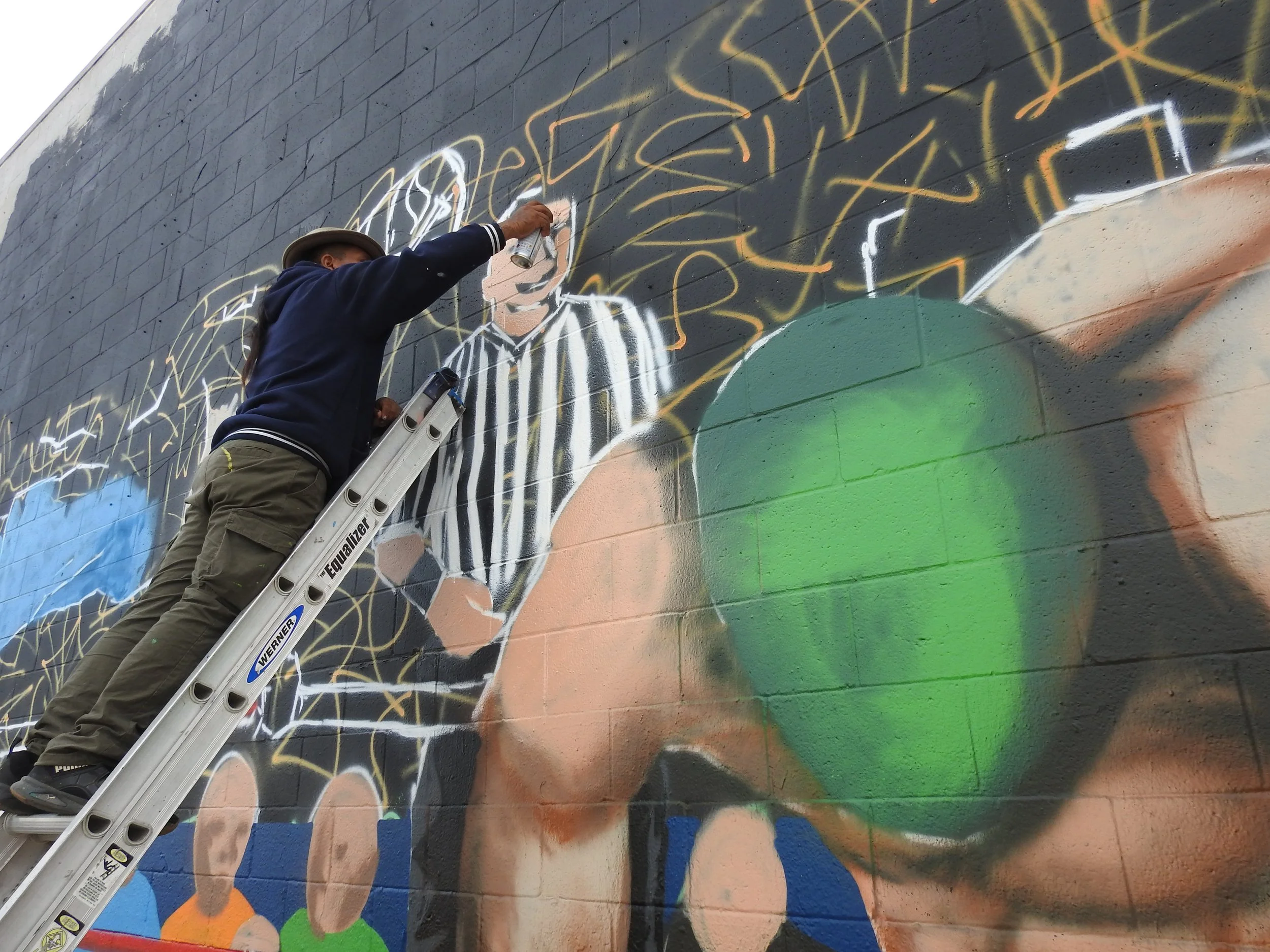
Dentlok perfecting the line work in the Rey Mysterio mural. Commercial Avenue 2023.
A nationwide conflict
Artists in Barrio Logan are not alone in facing off against gentrification. In Chicago’s Latino neighborhood of Pilsen, a 2023 study by Mapping Global Chicago delineated gentrification’s spread over two decades and its effect on residents. Household income rose significantly as lower-income individuals were displaced. Researchers found that the increase in median income did not stem from an increase in the wealth of native residents of Pilsen, but from new, mostly white young professionals.
For residents of Barrio Logan and Logan Heights, gentrification is not an abstract concept. Jennifer Cardona, a community organizer and local business owner, has lived in Barrio Logan since 2012. In 2020, she opened Thirty Flirty Shop, an art supply and artisan boutique on the Barrio’s iconic Logan Avenue.
By 2024, Cardona could no longer afford the frequent rent hikes. “I see gentrification as something much deeper than new buildings or redevelopment,” she said. “Our neighborhood has always changed, but what is happening now feels intentional and harmful.”
“Developers often say that rising property values are good, but those benefits are not for us. For many families here, it brings fear and instability,” Cardona added. “It is heartbreaking to watch people who have been here for generations get priced out. It is also painful to see Logan Avenue promoted as a trendy destination while the people who created its beauty and culture are treated as if they do not belong.”
Cardona also believes that brazen destruction of public art is a symptom of uncontrolled gentrification, a telltale sign of a dying social ecosystem that’s losing the essential diversity it once embraced.
“Our murals are not just paint. They are stories, history, ancestors, pride, and identity,” Cardona said. “They were created by and for the people who have lived here long before developers ever looked our way. So when these murals are painted over or removed, it sends a very clear message that our culture and our community are not valued.”
Despite the closure of small businesses like Cardona’s, Barrio Logan’s revolutionary spirit and history, and its proximity to industrial centers like the Port of San Diego and its various shipyards, have made it more difficult for developers to infiltrate than other neighborhoods. Historically, residents in Barrio Logan and Logan Heights have been vocal and aggressive in pushing back against gentrification.
“Our murals are not just paint. They are stories, history, ancestors, pride, and identity.
They were created by and for the people who have lived here long before developers ever looked our way. So when these murals are painted over or removed, it sends a very clear message that our culture and our community are not valued.”
Jennifer Cardona, community organizer, local business owner
Lucas Cruz, former chairman of the Chicano Park Steering Committee and co-owner of a local community art space, has long championed public art preservation and anti-displacement efforts in the region. He said what’s been lost in the rush to redevelop Barrio Logan is the area’s distinct – and valuable – neighborhood charm.
He’s concerned that residents are often unaware of changes planned for their own neighborhood. Many outside buyers, he added, seem uninterested in a community’s history or the wishes of longtime residents.
“Seeing these new housing developments going up (in Barrio Logan) raises concern for me,” Cruz said. “I feel like there are people who are just still struggling to pay their rent and make ends meet that we never hear from.”
For now, Barrio Logan artists, activists, and residents are sounding social media and activist drums, building awareness of their fight against unchecked development.
Lucas Cruz said the conflict has the neighborhood at a crossroads: Money versus murals.
The muralist Angeles is betting on art. Last November, with the help of Mario Torero and Sarah Mondragon, he secured permission to paint a wall with a new mural honoring WWE Hall of Fame wrestler Rey Mysterio and other iconic Lucha Libre (wrestling) stars. The new work is a few blocks from where “Birth of the Hummingbird” once stood.
Angeles used $1,500 of his own money to kickstart the project, and community donations helped finish the mural.
“This was a gift to the community,” Angeles said. “It’s a statement that we’re here, and we’re not leaving. Our culture stands strong, and like luchadores, we don’t give up!
—
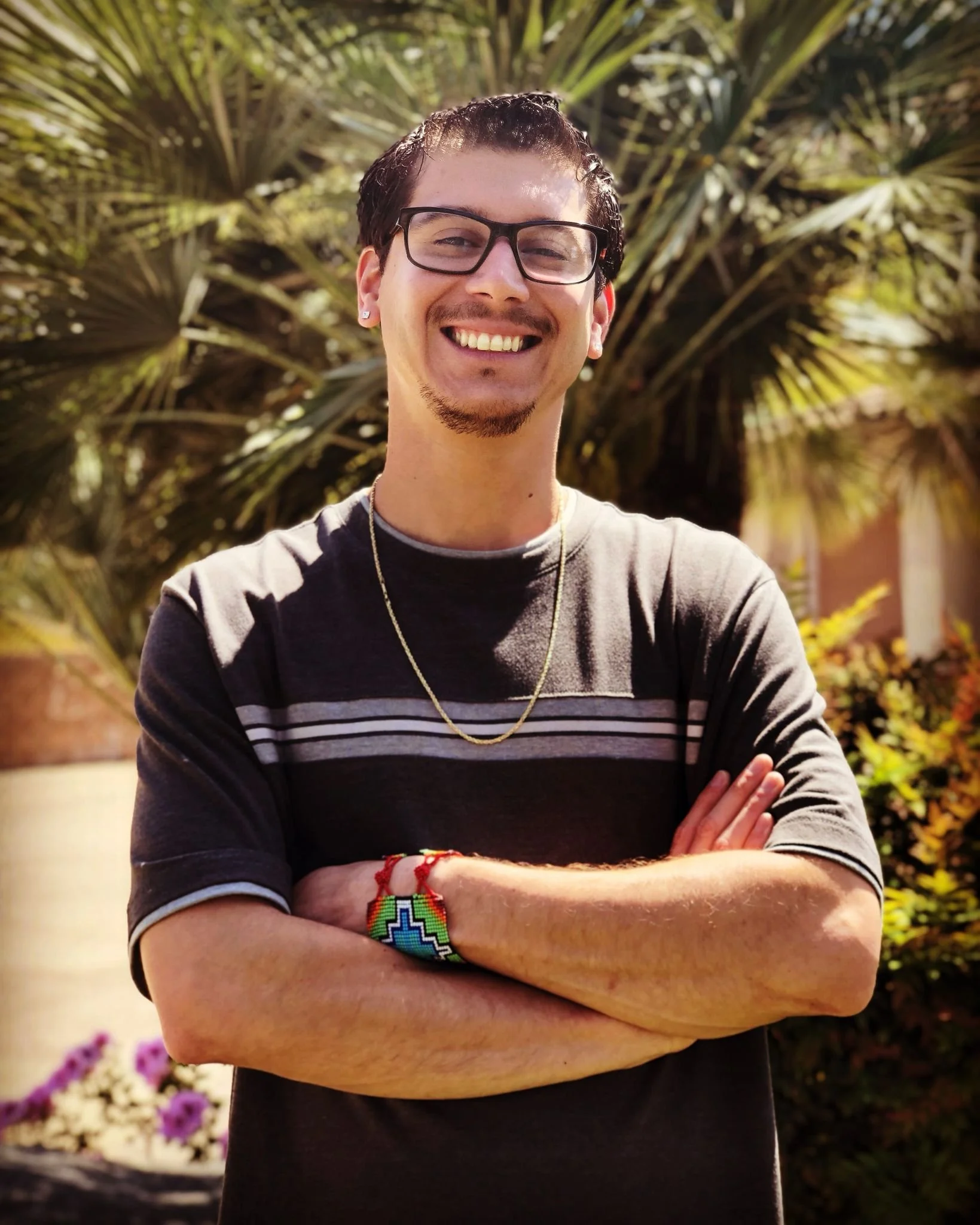
Roberto Camacho is a freelance Chicano journalist in San Diego. He is a graduate of the Walter Cronkite School of Journalism and Mass Communication at Arizona State University and Vice President of the San Diego/Tijuana NAHJ chapter. @Rob_Camacho_SD

Jesse " T.C. " Cannon is a photographer & hip hop artist in San Diego. He is a former political prisoner and is currently working as a photographer for Aztlan Archives & Snail Cage Records. Cannon was the main photographer for the Chicano Park Mural Restoration Project in 2023 & took over 6,000 photos of the project. @cano_photography_pt2
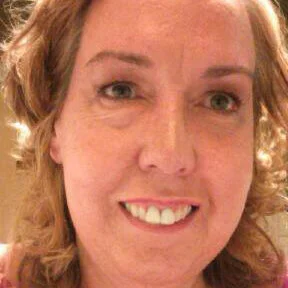
Patricia Guadalupe, raised in Puerto Rico, is a bilingual multimedia journalist based in Washington, D.C., and is the co-managing editor of palabra. She has been covering the capital for both English- and Spanish-language media outlets since the mid-1990s and previously worked as a reporter in New York City. She’s been an editor at Hispanic Link News Service, a reporter at WTOP Radio (CBS Washington affiliate), a contributing reporter for CBS Radio network, and has written for NBC News.com and Latino Magazine, among others. She is a graduate of Michigan State University and has a Master’s degree from the Graduate School of Political Management at George Washington University. She is the former president of the Washington, D.C., chapter of NAHJ and is an adjunct professor at American University in the nation’s capital and the Washington semester program of Florida International University. @PatriciagDC