
Is It Real?: Generative AI and Misinformation in Latino Communities Pose New Challenges
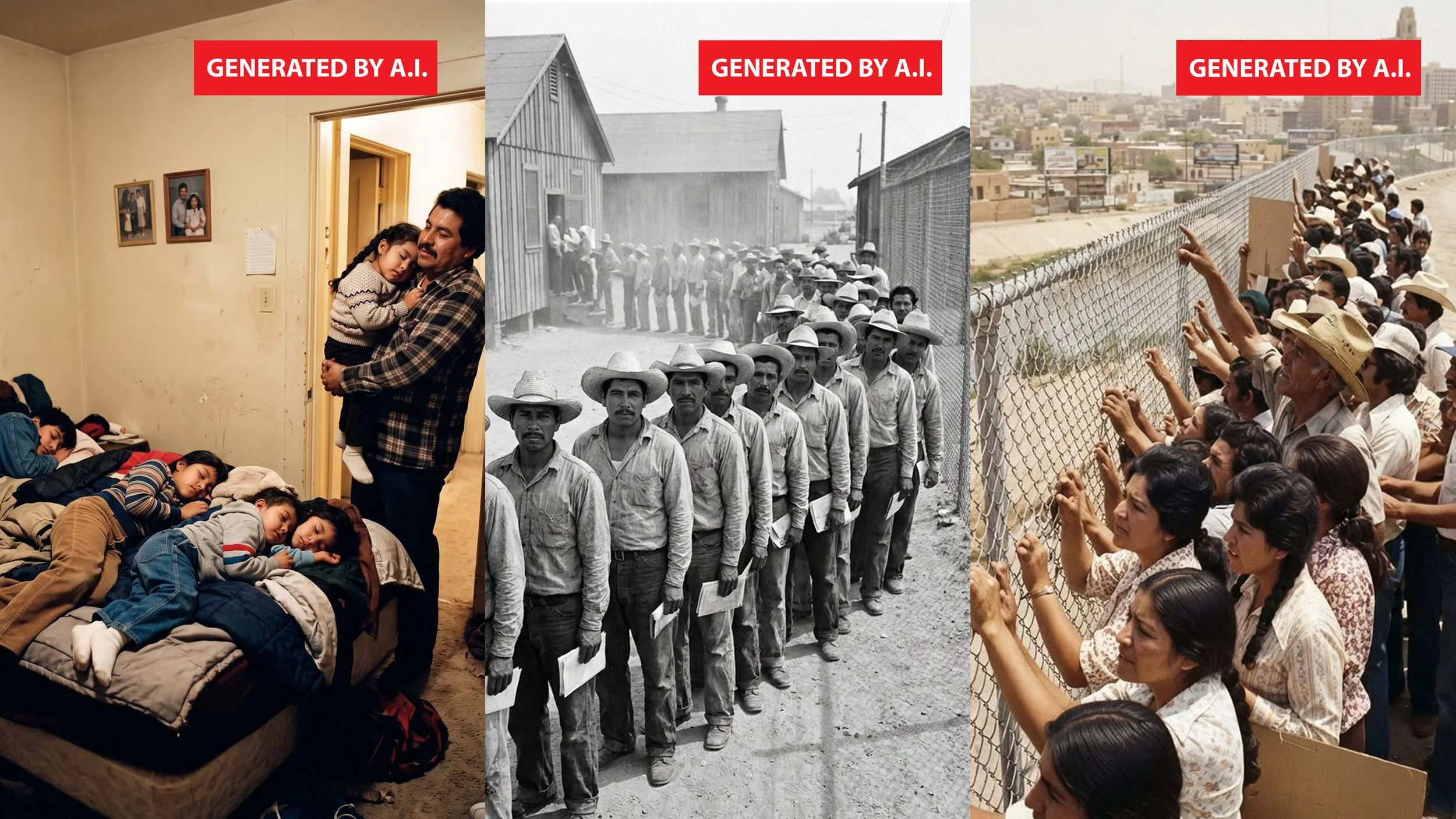
Fake interactions with ICE agents or fictional reenactments of Chicano and Latino historical events go viral daily on social media without any warning or moderation from the platforms.
Clic aquí para leer en español.
Text by Roberto Camacho, @rob_camacho_sd
Edited by Douglas Gómez Barrueta
Artificial intelligence is fundamentally changing how misinformation spreads. As generative AI floods the digital landscape, the struggle to separate fact from fiction has been especially felt in Latino communities as AI-generated video and imagery increasingly target them. Driven by "less platform content moderation in Spanish" and a high reliance on unverified digital sources by Latino communities.
The trend has even crept into the realm of immigration as viral videos of violent and deadly encounters between the public and ICE have become political flashpoints in the U.S. One video flashes across the screen. The video with more than 8.5 million views depicts a female NYPD officer verbally confronting an ICE agent before ripping off his mask. Another with nearly 6 million views shows a Mexican woman striking an agent.
The confrontations are stunning, but something doesn’t feel right. Movements from the people feel off. Letters and signage in the background don’t make sense, and dialogue in the dramatic confrontations sounds rehearsed or robotic. The videos in question are AI-generated. One of thousands in a troubling subgenre of AI-slop content depicting fake encounters between the public and federal agents.
subscribe to palabra’s newsletter
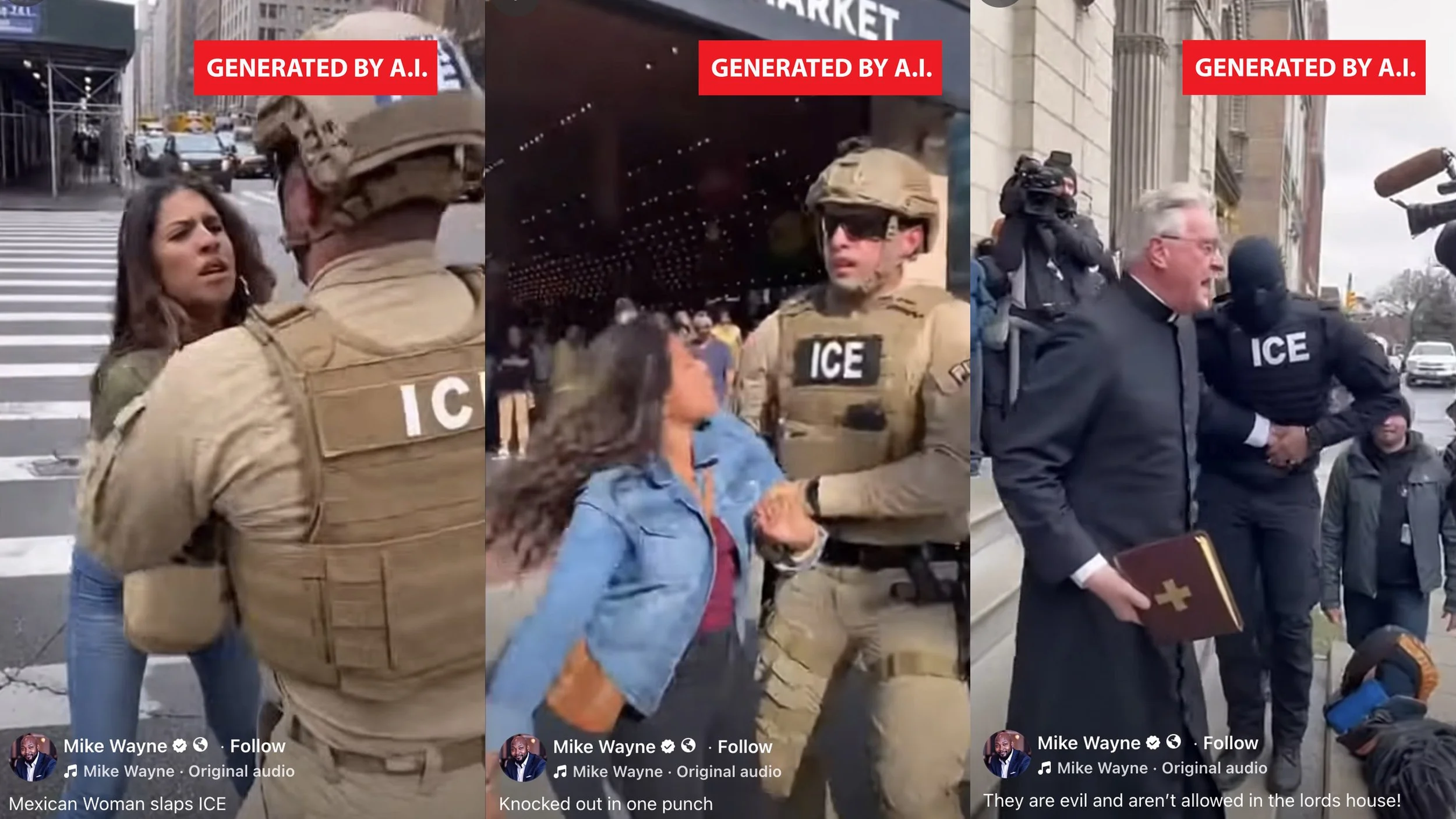
Screenshots of AI-generated videos depicting scenarios of people resisting and assaulting ICE agents. Credit: Screenshot from Mike Wayne Facebook page.
Mike Wayne, one of the most prolific accounts creating AI-generated ICE videos on Facebook and Instagram, has posted thousands of AI-generated videos depicting fake encounters with ICE agents. Frequently depicting people of color resisting, confronting, or physically engaging ICE agents; racking up tens of millions of views. The person or people behind the page did not respond to palabra’s request for comment regarding the page’s content.
Jeremy Carrasco is the founder of Riddance, a media intelligence company that tracks AI-generated content on social media. He also creates AI and media literacy videos as JeremyFindsAI on social media channels to help people identify synthetic media and understand where to get human-made information and entertainment. Carrasco says that the situations depicted in AI-generated videos of fake interactions with ICE set up a false premise of security and ultimately a false reality that are not reflective of dangers in the real world.
Generative AI Fractures Our Shared Reality
In January 2026, the Twin Cities region was rocked by two high-profile shootings of Renee Good and Alex Pretti, during Operation Metro Surge. A large-scale immigration enforcement operation conducted by ICE and Customs and Border Protection in Minnesota between December 2025 and February 2026. Carrasco, who is based out of St. Paul, Minnesota, just east of Minneapolis, says the chaos and confusion following both shootings underscore the inherent risk of videos that misrepresent the realities and very real danger that both citizens and undocumented people alike face during interactions with ICE.
Support the voices of independent journalists.
|
“These videos are not representative of reality at all. And in the case of AI interactions with ICE, they’re either misrepresentative about how the law works or how the law would protect undocumented people”, Carrasco said. “The idea that ICE would be receptive to these sorts of interactions isn't actually borne out in real videos of them, where they are actually quite aggressive and would not respond kindly to someone throwing food at them.”
Carrasco said that AI-generated accounts often don't have specific motivations beyond getting views and attention, and whether content is disinformative or harmful is not something being taken into account.
“Oftentimes, those factors aren't explicitly considered by the person or the operation that's running these accounts. It's a game for them (AI pages). They spam AI scenarios like ICE accepting gasoline spraying, slapping, or things like police arrests or rejection by security and other fan fiction scenarios”, Carrasco said. “This is just another day of spamming AI-slop for them, but especially right now, they're creating noise and a fake reality when our own reality needs real information more than ever.”
The site is just one of several that have published thousands of AI-generated ICE videos that have gone viral across Meta’s social media platforms. Misinformation and misleading content have exploded across the company’s platforms after Meta dismantled its fact-checking and content moderation program following the 2024 Presidential election to have fewer restrictions on political content.
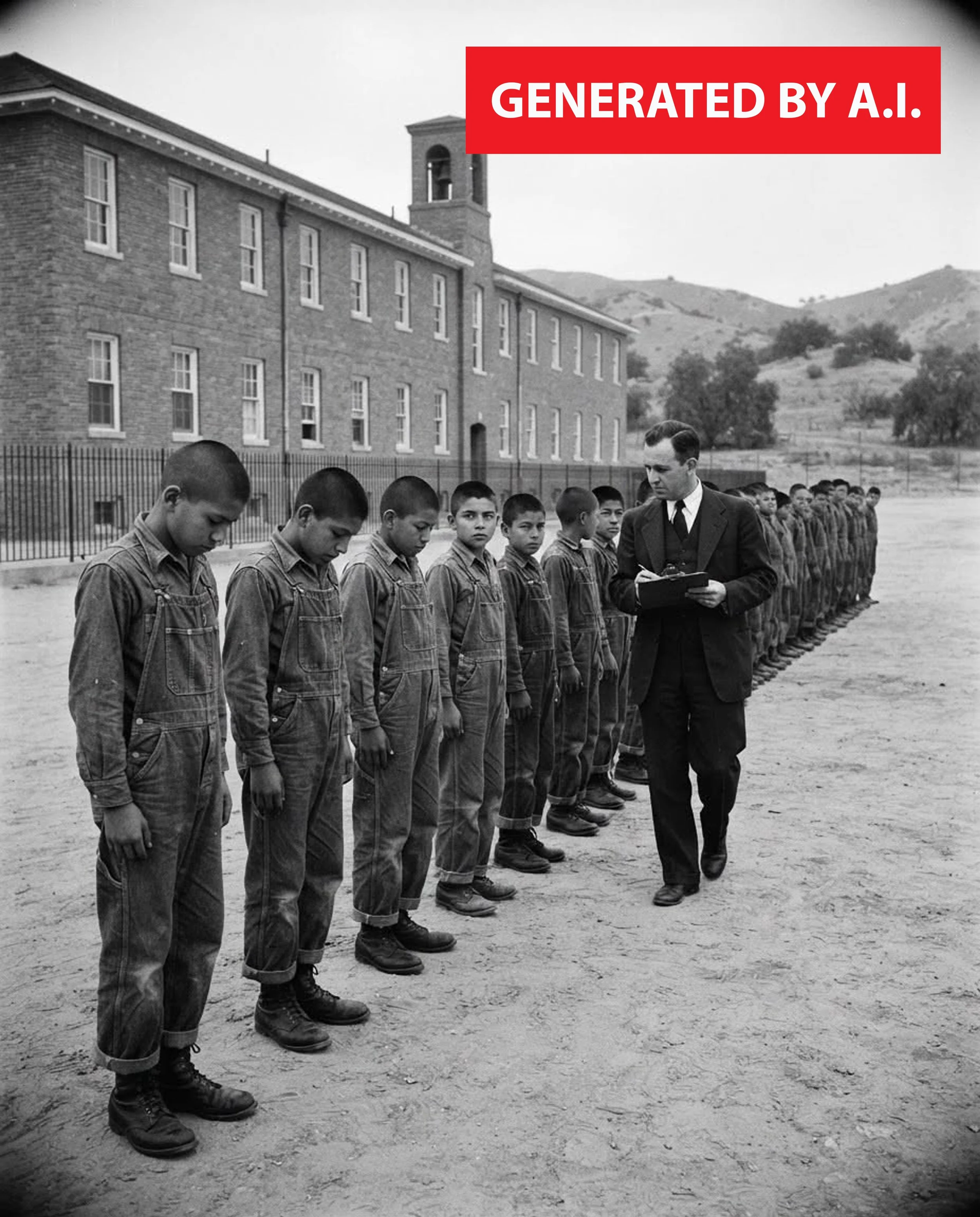
AI-generated image designed to resemble an old historical photo depicting Mexican-American boys at the Whittier State School (later known as the Fred C. Nelles Youth Correctional Facility). Credit: screenshot from the Lost Mexican America Facebook page.
Despite this increase, tech companies largely seem unbothered by the proliferation of misinformation and AI content. Meta CEO Mark Zuckerberg has brushed off concerns about Meta’s more lax approach to misinformation, even going so far as to say that its changes are a “trade-off” that will allow more “bad stuff” to circulate on Meta’s social media platforms.
Meta’s independent Oversight Board, often referred to as the company’s “supreme court,” however, has repeatedly criticized the company's handling of AI-generated material, even going as far as to say that Meta's rules for addressing AI deepfakes are “consistently and fundamentally inadequate” to address the explosion of AI deepfakes across its platforms.
The board has also recommended nine policy changes at Meta, including the demotion of content labelled “high risk” from algorithms, effectively making content less likely to appear in users’ feeds. It also recommended that Meta make it more difficult for users to view AI-generated content by introducing a warning screen that requires a click-through before viewing AI-generated content. Critics and the board itself, however, have acknowledged it has struggled to fix systemic enforcement flaws, reduce Meta's reliance on automated moderation, and has no influence steering Meta’s foundational product, business, or engineering choices.
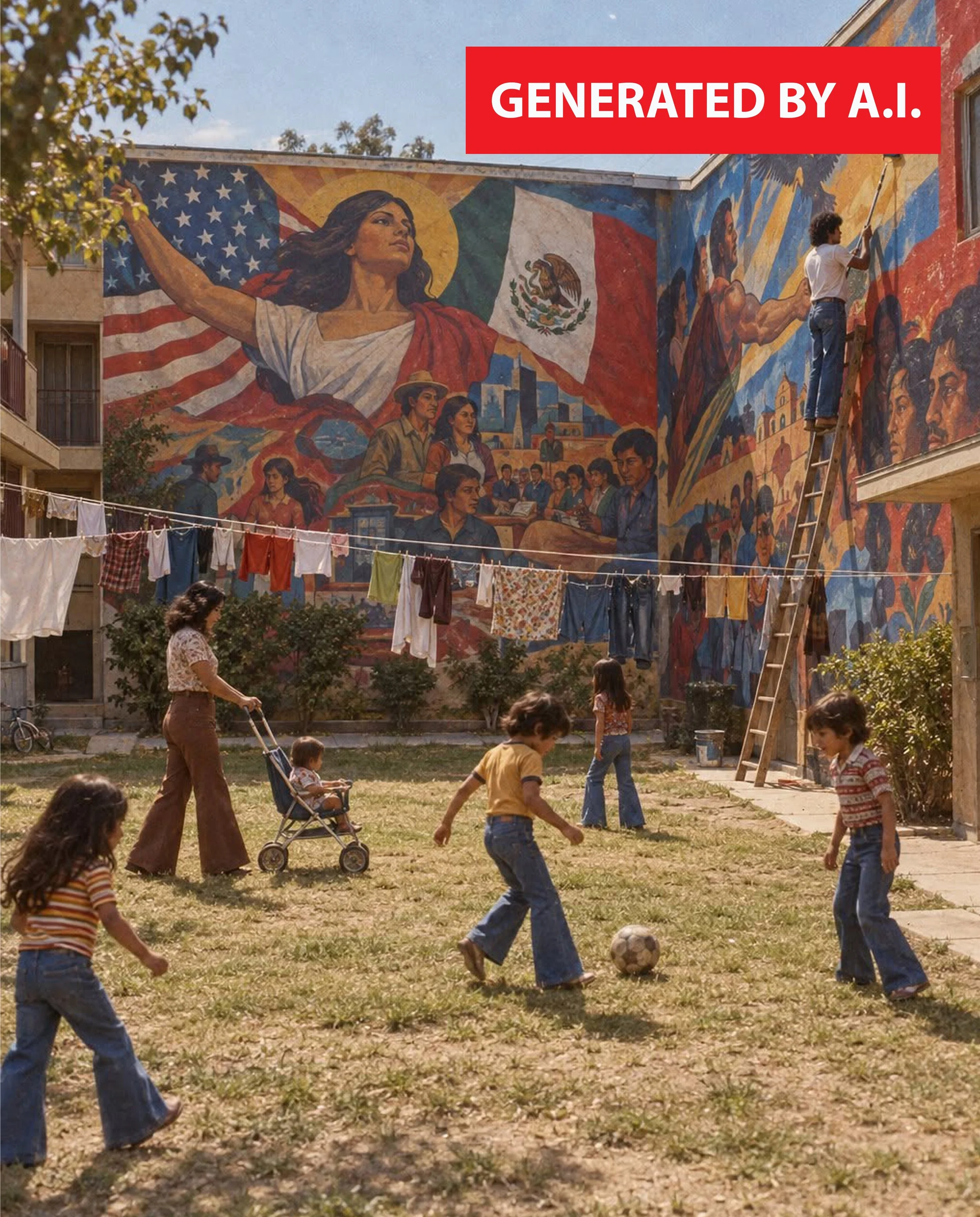
AI-generated image designed to resemble an old historical photo depicting murals at the Estrada Courts housing project in East Los Angeles. Credit: screenshot from the Lost Mexican America Facebook page.
Dr. Jieun Shin, an associate professor at the University of Florida's College of Journalism and Communications, teaches and researches social media dynamics with a focus on fact-checking and the spread of misinformation. Shin notes that while misleading information has always existed, the problem has only been exacerbated by social media platforms’ failure to implement moderation for AI-generated content. Now, generative AI has allowed bad actors to generate misinformation at an unprecedented scale. “Misinformation used to be a distribution problem. With AI, misinformation is increasingly a production problem,” Shin said. “AI makes it really easy to generate a large amount of fake information, whether it's video or audio, at scale, cheaply, at an increasingly fast pace. And this has fundamentally changed the scale and speed of the challenge.”
Distorting Latino History
Generative AI video is not the only format targeting Latinos online either. AI slop accounts masquerading as Chicano/Latino history pages have found particular footholds among Latino audiences across social media platforms. AI-generated pages, such as Lost Mexican America on both Facebook and Instagram, target English-speaking Chicanos/Mexican Americans.
Another page, Raices Mexicanas MX, engages in the same strategy, targeting a Spanish-speaking audience. These pages publish dozens of posts daily across Meta's platforms. s. Other pages have even larger audiences. Mexican American Roots has over 90k followers on both its Facebook and Instagram pages. Across Meta’s platforms, all three pages cumulatively have hundreds of thousands of followers, with posts regularly going viral due to the platform's algorithm design to automatically amplify content that captures early user engagement and inject content into the feeds of non-followers. None of the page managers responded to palabra’s requests for comments.
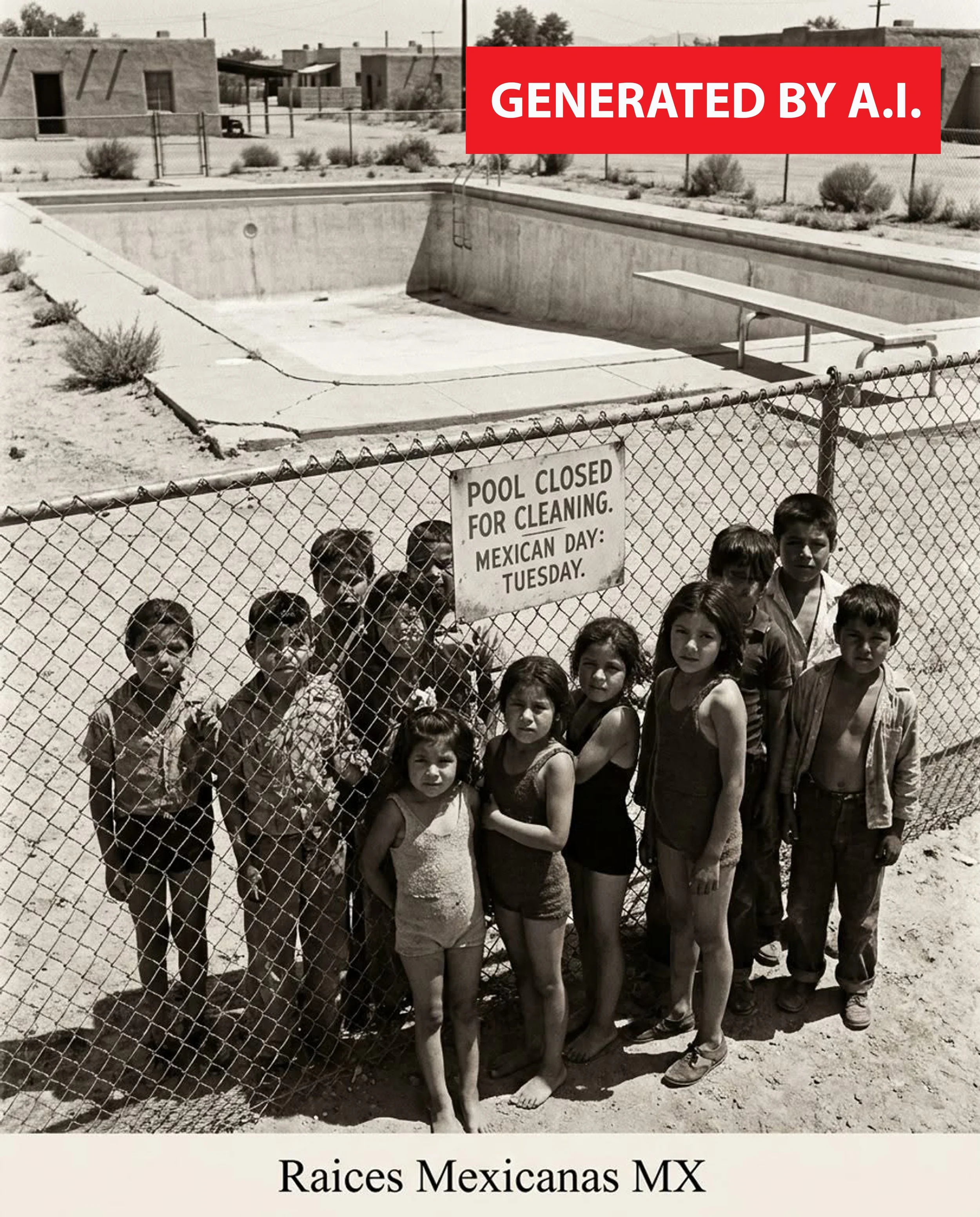
AI-generated image designed to resemble an old historical photo depicting pool segregation in the U.S. Southwest. Credit: screenshot from Raices Mexicanas MX's Facebook page.
Many images created by the pages are intentionally made to resemble actual historical photos, often with no AI tags or disclaimers to inform audiences. The information shared by the pages also often includes errors, omissions, and half-truths. This has raised concern from educators and historians about the dangers of pseudo-history on social media and the real risk of flooding out real primary sources and historical photography online with fake AI-generated imagery.
Dr. Santos Felipe Ramos, an associate professor and the program coordinator of Latin American and Latino/a Studies at Grand Valley State University, has spoken about the sharp rise in the number of accounts on social media using AI to generate content about Chicano/Latino and Indigenous history and the negative impact they have on communities.
Ramos says that Chicanos and Mexican-Americans are particularly susceptible because they prey on the emotional and cultural factors that drive people to seek out such content in the first place. “For Mexican-Americans in particular, AI history accounts exploit the community’s Indigenous heritage. Visually, they present the idea of, ‘here is what our ancestors looked like thousands of years ago…here is how we’ve been oppressed...but we are very proud of who we are culturally, and we’re fighting back,’ Ramos said. “These accounts are willing to tell you anything so long as it will keep you engaged.”
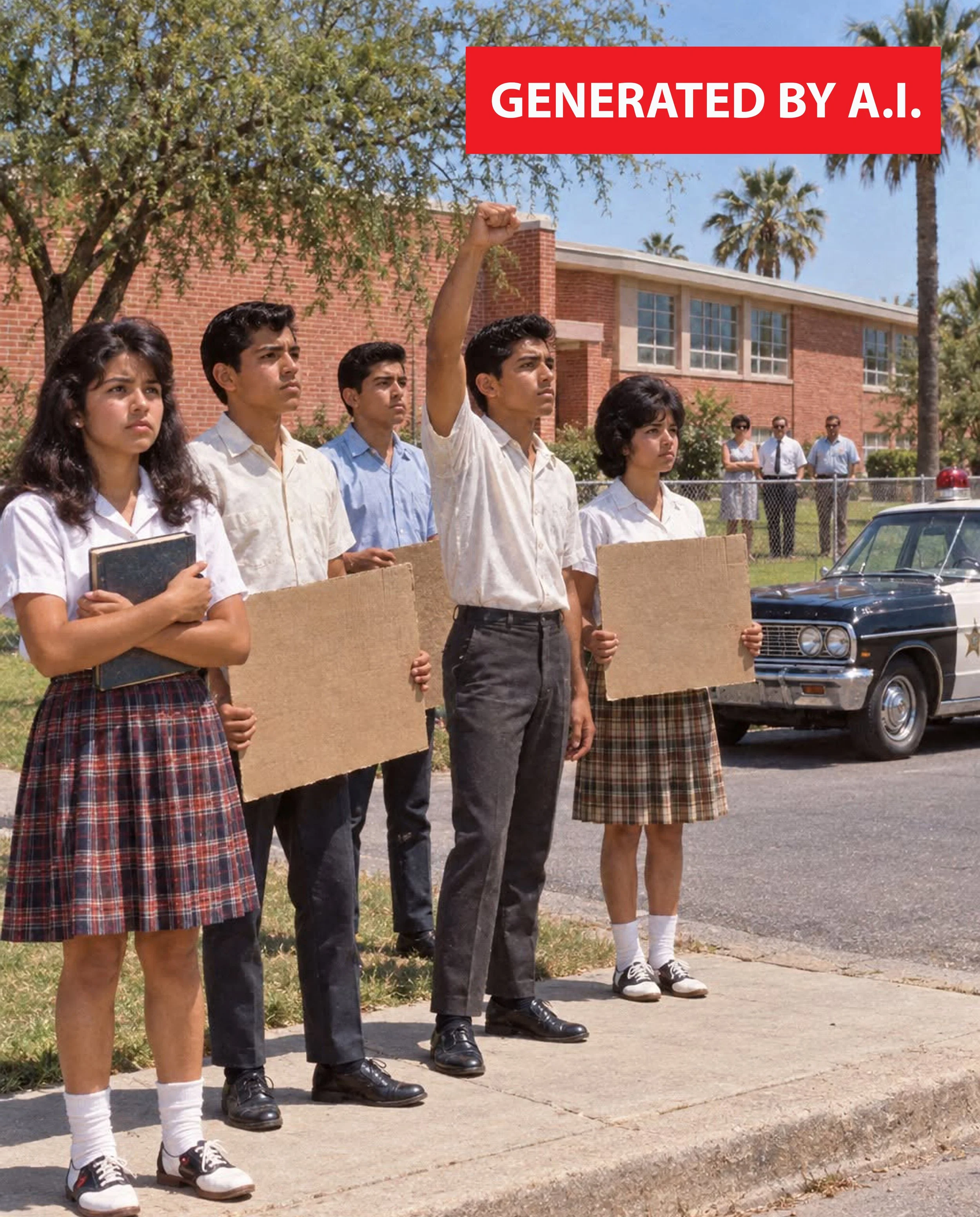
AI-generated image of students holding blank signs designed to resemble old historical photos depicting the Chicano student walkout at Gillett Junior High in Kingsville, Texas, in 1969. Credit: screenshot of Lost Mexican America Facebook page.
Ramos says that in addition to perpetuating false information and narratives, AI-generated history accounts also silence Chicano/Latino communities by robbing users of shared experiences and human-to-human interactions with one another that are required for cultural exchange. “AI-slop pages replace the voices of actual people, and they manipulate our communities,” Ramos said. “The point of culture, art, music, stories, etc., is not simply about gathering and hoarding information. It's about human connection, and we're literally replacing ourselves and our connection with one another when we uplift AI-generated music, art, and history.”
For years, researchers have also known that Spanish speakers or those who speak English as a second language are more vulnerable to online misinformation. Researchers have linked these disparities, in part, to fewer resources for moderating Spanish-language content. A heavier reliance on social media and messaging apps among Latinos to consume news, and bad actors frequently weaponizing cultural anxieties. Generative AI, however, has amplified the reach of online misinformation.
Before the generative AI boom, studies showed that Latinos already had a higher propensity to be manipulated by misinformation. According to a study from the human rights nonprofit Avaaz, Latinos have a higher propensity to fall victim to misinformation on Facebook. Language accounts for much of this disparity, with misinformation in Spanish-language content only being flagged about 30% of the time, while English-language content is flagged at a much higher 70% average.
Marisa Abrajano, a professor of political science at UC San Diego, co-authored a study published in PNAS Nexus showing that Latinos who rely on Spanish-language social media for news were significantly more likely to believe false political narratives than those who consume English-language content. Abrajano says chasing virality or monetization by leaning into controversial or emotionally charged content through online media is nothing new. However, the ability to create very realistic photos and videos with generative AI has significantly complicated the information environment.
Abrajano also says that disinformation is often shared within trusted personal networks such as family members, community pages, or unverified independent social media accounts. The phenomenon is especially pronounced on Facebook, which, unlike other social media platforms built purely on passive scrolling, relies heavily on direct shares between family, friends, and community groups. Creating a compounding chain reaction that makes false claims feel more authentic and more pervasive for users.
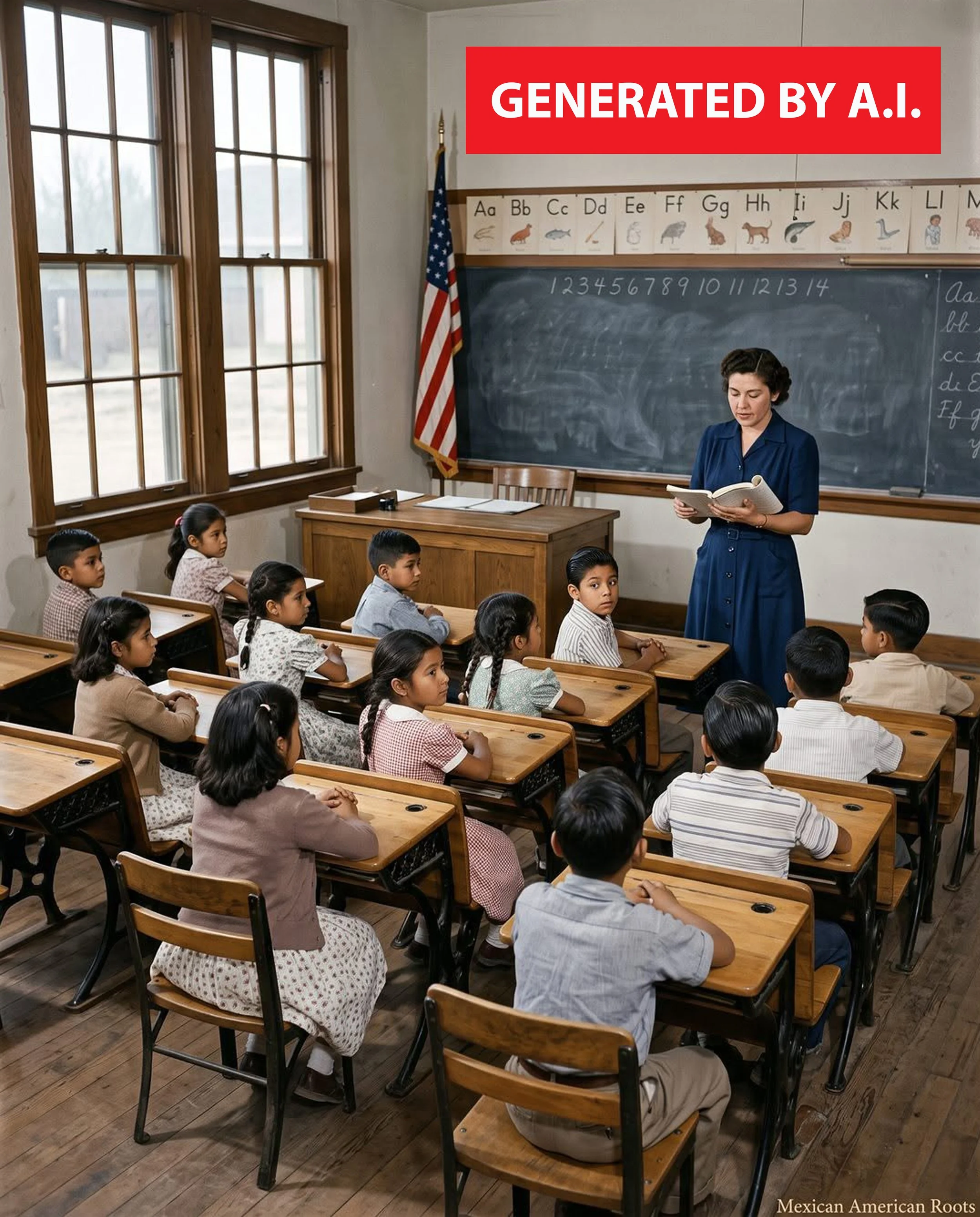
AI-generated image designed to resemble an old historical photo of Mexican-American children in an elementary school classroom setting. Credit: screenshot of Mexican American Roots
“Even for the most educated and politically savvy individual, detecting fake versus real videos isn’t that straightforward,” Abrajano said. “The burden is on individuals to want to learn what’s real versus what’s fake, and oftentimes, people just don’t have the time and resources to do so.”
That trend appears to also track across AI-generated pages as well. Pages like “Raices Mexicanas MX” that target Spanish-speaking audiences have no disclaimers on Facebook. None of the accompanying Instagram pages had any labeling for AI-generated images or video. Meta did not respond to multiple requests from palabra for comment regarding how its platforms manage AI-generated misinformation or its impact across its networks.
“Even for the most educated and politically savvy individual, detecting fake versus real videos isn’t that straightforward,” Abrajano said. “The burden is on individuals to want to learn what’s real versus what’s fake, and oftentimes, people just don’t have the time and resources to do so.”
—Marisa Abrajano, professor of political science at UC San Diego
Confronting AI-Enabled Misinformation
The inconsistent labeling underscores how tech companies’ approach to addressing AI-misinformation have been spotty and piecemeal at best. Some tech companies have taken proactive approaches to address image verification. In 2021, Adobe, Arm, BBC, Intel, Microsoft, and Truepic founded C2PA (Coalition for Content Provenance and Authenticity), an open-source technical standard that embeds tamper-evident metadata directly inside digital files to trace their origin and editing history. The coalition was started to develop open, technical standards for certifying the source, history, and evolution of digital media to combat online disinformation.
The hodgepodge of tech and social media companies with varying degrees of commitment to addressing AI-generated misinformation has left users in a digital wilderness where oversight is still lacking. Experts remain divided on what approach is best to tackle AI-generated content and misinformation. However, most agree that tech companies and social media platforms have to take a more proactive role in moderating content and addressing deliberately deceptive content.
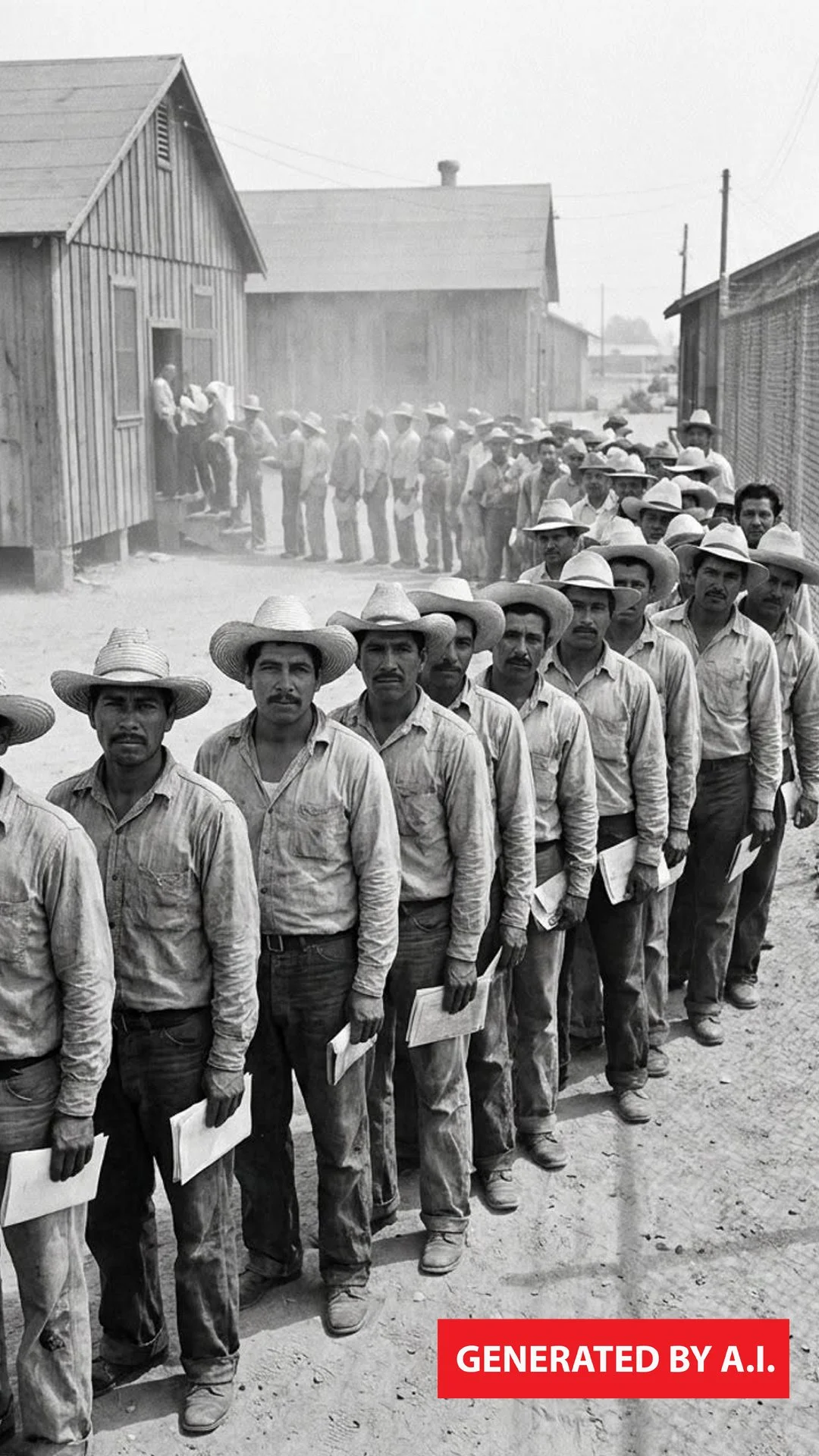
AI-generated image posted by Raices Mexicanas MX, an AI-slop Facebook page targeting Spanish speakers, designed to resemble an old historical photo of workers in the Bracero Program. Credit: screenshot of Raices Mexicanas MX
“This is something that needs to be done by platforms. They need to be the ones incentivized to fix this problem,” Jeremy Carrasco said. “Social media platforms actually have to take this very seriously very soon, because right now, AI media is still detectable by some types of normal people. Which means you could still theoretically start scaling a solution. Right now it's still approachable.”
Carrasco believes local journalism has been underappreciated in its ability to address misinformation. “In fast-moving situations and really important breaking news, it’s actually important to go to a news source that verifies the media before they post it. Which means not meme pages and not individual reposters”, Carrasco said. “When you're in these scenarios, it's impractical to just trust random things that come up on your feed. Unfortunately, that's how most people consume media.”
Others, such as Dr. Ramos, believe more pressure needs to be placed on both the federal government and the tech companies to take safety concerns seriously and that marginalized communities in particular need to make efforts to build communities outside of the digital realm. “While it is important for us to resist AI as individuals, true accountability needs to happen on a structural level. Social media companies need to regulate AI use on their platforms, and they will not do this without legislation requiring them to do so, and our government unfortunately won’t do this without pressure from our communities,” Ramos said. “I think we have two primary paths in fighting back against AI in this context…one is to put pressure on government and tech companies to pass regulations on AI, and the other is to build community outside of these virtual contexts altogether.”
—

Roberto Camacho is a multimedia Chicano journalist from San Diego, California. He is a graduate of the Walter Cronkite School of Journalism and Mass Communication at Arizona State University. His reporting typically focuses on criminal justice reform, immigration, Chicano/Latino issues, Hip-Hop culture, and their intersections with social justice. @rob_camacho_SD